
10 Best Shopify Alternatives in 2026: Find Your Perfect E-Commerce Platform
Introduction: Why Thousands Are Leaving Shopify in 2026
Shopify built the e-commerce empire. But in 2026, it's no longer the only option—and for many sellers, it's not even the best one.
If you're here, you probably already know the pain: transaction fees stacking on top of app subscription costs, limited customization without hiring developers, poor inventory management across channels, or simply feature bloat you'll never use. You're not alone. Thousands of e-commerce entrepreneurs are actively searching for Shopify replacements—platforms that charge fairly, give you real control, and integrate the tools you actually need.
The good news? There are genuinely better alternatives now. Not just band-aids, but full-featured platforms that rival Shopify at half the cost and double the simplicity.
Here's what we'll cover:
The best all-in-one alternative for creators and coaches
Budget-friendly options that don't sacrifice features
Enterprise solutions for scaling businesses
Niche platforms built for specific business models
A side-by-side comparison so you can decide in minutes
Let's find your next home.
Quick-Scan List: The 10 Best Shopify Alternatives
Systeme.io — Best overall all-in-one platform
WooCommerce — Best for customization and control
ThriveCart — Best for high-ticket offers and funnels
Stripe Shop — Best for minimal fees and simplicity
BigCommerce — Best for enterprise and scaling
Wix eCommerce — Best for beginners with design needs
Square Online — Best for brick-and-mortar + online blend
SamCart — Best for digital products and courses
Gumroad — Best for independent creators
Etsy — Best for crafts, secondhand, and niche products
Alternative #1: Systeme.io — Best Overall Shopify Alternative
Why Systeme.io Wins for Most Businesses
If you're tired of Shopify's fragmented ecosystem, Systeme.io delivers everything in one dashboard—without the complexity. It's built for entrepreneurs, not enterprise IT teams. That means you'll actually use what you pay for.
Here's what makes it genuinely different:
Core Features & Benefits
✅ All-in-one platform: Sales funnel + email marketing + landing pages + store + courses + memberships—no third-party app patchwork required
✅ No transaction fees: Unlike Shopify's 2.9% + $0.30 per transaction, you keep 100% of what you sell (except payment processor fees)
✅ Drag-and-drop funnel builder: Create high-converting sales funnels without touching code—optimized for upsells, downsells, and order bumps
✅ Integrated email automation: Build sequences, segment audiences, and recover abandoned carts without paying $30/month for Klaviyo
✅ One pricing tier, unlimited growth: Start at one price, scale to millions in revenue without tier jumps—perfect for bootstrapped founders
✅ Professional templates: 100+ pre-built funnels, landing pages, and store templates designed to convert
✅ Built-in affiliate system: Launch affiliate programs directly in your dashboard—no external tools needed
Pricing Breakdown
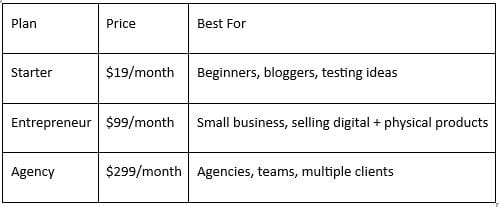
What you don't pay: Transaction fees, app overages, hidden processing charges.
Why It Beats Shopify Specifically
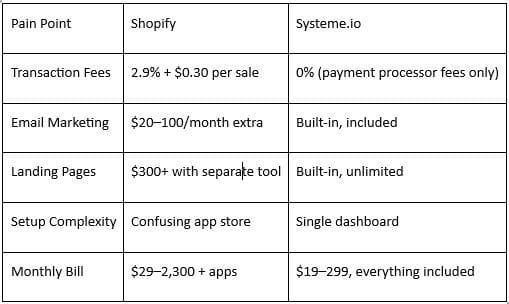
For a business doing 10,000/month in sales, Systeme.io saves 3,500+ annually** compared to Shopify + email platform.
No credit card required. Full access for 14 days.
Alternative #2: WooCommerce — Best for Customization and Control
What It Is
WooCommerce is the WordPress plugin powering 38% of all e-commerce sites. It's the most customizable platform on this list—if you're willing to get your hands dirty.
Strengths
✅ Infinite customization: WordPress + WooCommerce = total control over design and functionality
✅ No vendor lock-in: You own your site, your data, and your customer list
✅ Massive ecosystem: 50,000+ plugins extend functionality however you need
✅ SEO-friendly by default: Built on WordPress, Google loves it
✅ Lower fees: Only payment processor fees (typically 2.9% + $0.30)
Weaknesses
❌ Steep learning curve: You need to manage hosting, security, backups, updates, plugins
❌ Hidden costs: Developer fees, hosting ($100–300/year minimum), security plugins add up
❌ Slower performance: Requires optimization and good hosting to stay fast
❌ No built-in email marketing: You'll need Mailchimp, ConvertKit, or similar
Pricing: Free (plugin) + $100–300/year hosting + optional premium plugins
Best For: Developers, agencies, businesses that need unique features.
Alternative #3: ThriveCart — Best for High-Ticket Offers and Funnels
What It Is
ThriveCart is built for coaches, consultants, and creators selling $100+ digital products. It's funnel-first, with powerful upsell/downsell mechanics.
Strengths
✅ Aggressive upselling: One-click upsells, order bumps, and downsells are native—not bolted-on
✅ Flat-rate pricing: $297/month, regardless of revenue (huge win for high-ticket sellers)
✅ Integrated email campaigns: Autoresponders built-in, perfect for nurture sequences
✅ Payment plan splits: Sell $2,000 courses as monthly payments—no third-party tool needed
✅ Affiliate management: Native affiliate dashboard with real-time tracking
Weaknesses
❌ Not ideal for physical products: Built for digital goods and services
❌ Higher monthly cost: $297/month is steep for micro-businesses
❌ Limited customization: Less flexible than WooCommerce
Pricing: $297/month (flat fee, unlimited revenue)
Best For: Digital course creators, consultants, coaches selling high-ticket offers.
Alternative #4: Stripe Shop — Best for Minimal Fees and Simplicity
What It Is
Stripe Shop is Stripe's lightweight storefront. It's deliberately minimal—no frills, just a beautiful way to sell online.
Strengths
✅ Industry-lowest fees: 2.2% + $0.30 (Stripe's standard rate, lower than Shopify)
✅ Dead simple setup: 10-minute store, no code required
✅ Free to start: Only pay when you make sales
✅ Beautiful, mobile-first design: Customers get a premium experience by default
✅ Tax and shipping built-in (simplified)
Weaknesses
❌ No email marketing: You'll need a separate platform
❌ Limited customization: Stripe-branded, fewer design options
❌ No funnel building: Single-product or catalog only, no upsells
❌ No membership/recurring billing (yet)
Pricing: Free setup + 2.2% + $0.30 per transaction
Best For: Micro-sellers, product creators, creators testing new products.
Alternative #5: BigCommerce — Best for Enterprise and Scaling
What It Is
BigCommerce is Shopify's enterprise rival—built for serious online retailers doing $50K+ monthly revenue.
Strengths
✅ No transaction fees (on all plans)
✅ Built-in wholesale features: B2B selling, custom pricing per customer, purchase orders
✅ Advanced inventory management: Multi-warehouse, inventory sync, SKU tracking
✅ Powerful APIs: Integrate with anything—ERP, CRM, accounting software
✅ Better pricing tiers: More sales → lower % fees (up to 1.5% for high volume)
Weaknesses
❌ Expensive: $400–800/month minimum
❌ Steep learning curve: Powerful but complex
❌ No email marketing included: Third-party integration required
❌ Overkill for small businesses: You'll pay for features you don't need
Pricing: 400/month (Starter) to 800/month (Standard)
Best For: Scaling e-commerce businesses, B2B sellers, serious retailers.
Alternative #6: Wix eCommerce — Best for Beginners with Design Needs
What It Is
Wix combines website building with e-commerce—perfect for creators who want a beautiful site and a functioning store.
Strengths
✅ Gorgeous templates: Wix is famous for beautiful design—no coding required
✅ All-in-one: Website + store + email marketing in one place
✅ Beginner-friendly: Drag-and-drop everything, immediate results
✅ Professional look: Compete with big brands without hiring designers
✅ Built-in SEO tools: Wix has improved SEO significantly
Weaknesses
❌ Higher fees: 2.9% + 0.30+monthlysubscription(27–250/month)
❌ Limited customization: Can't move your site elsewhere without rebuilding
❌ Slower performance: Load times lag behind competitors
❌ App ecosystem smaller: Fewer integrations than Shopify
Pricing: $27–250/month (plan-dependent)
Best For: Beginners, creatives, small service businesses needing design + store.
Alternative #7: Square Online — Best for Brick-and-Mortar + Online Blend
What It Is
Square Online is built for businesses that sell both in-store and online—all connected to one inventory.
Strengths
✅ Unified inventory: One inventory syncs to in-store POS, online store, and social (Facebook/Instagram)
✅ Free store: No monthly fee—only pay transaction fees (2.6% + $0.40)
✅ Integrated payments: Works perfectly with Square hardware
✅ Real-time reports: See all sales channels in one dashboard
✅ Social selling: Direct Facebook and Instagram selling
Weaknesses
❌ Fewer design options: Less customizable than Shopify
❌ Basic email tools: No advanced automation
❌ No funnels or upsells: Catalog-only, not funnel-first
❌ Limited app ecosystem: Fewer third-party integrations
Pricing: Free + 2.6% + $0.40 per transaction
Best For: Retailers with physical + online locations, coffee shops, gyms.
Alternative #8: SamCart — Best for Digital Products and Courses
What It Is
SamCart is purpose-built for selling digital products, online courses, and memberships. It's Shopify's rival for the creator economy.
Strengths
✅ Digital product focus: Download delivery, license management, email sequences—all built-in
✅ Powerful upsells: One-click upsells, order bumps, and post-purchase sequences
✅ Bundle selling: Create product bundles with custom pricing
✅ Membership integration: Recurring billing, membership portals, drip content
✅ Affiliate-ready: Affiliate tracking and payouts built-in
Weaknesses
❌ Not ideal for physical products: Optimized for digital goods
❌ Pricing: 99/month(Starter)to 299/month (Marketplace)
❌ Limited design flexibility: Fewer template options
Pricing: $99–299/month (based on features)
Best For: Course creators, digital product sellers, membership businesses.
Alternative #9: Gumroad — Best for Independent Creators
What It Is
Gumroad is the creator's darling—simple, elegant, zero-nonsense selling for artists, writers, musicians, and indie makers.
Strengths
✅ Simplicity: Literally just upload a file and set a price—done in 60 seconds
✅ Low fees: Only 10% + payment processor (one of the lowest on this list)
✅ Creator-focused: Licensing, book selling, membership, course hosting—all supported
✅ Community features: Patrons, subscriptions, supporter-only content
✅ Automatic licensing: Customers get a unique license key for downloads
Weaknesses
❌ Very limited customization: Gumroad brand visible, minimal design control
❌ No funnels: No upsells, order bumps, or funnel mechanics
❌ No inventory management: Not built for physical products
❌ Small ecosystem: Few integrations or add-ons
Pricing: Free + 10% + payment processor fees
Best For: Indie creators, authors, musicians, artists selling digital work.
Alternative #10: Etsy — Best for Crafts, Secondhand, and Niche Products
What It Is
Etsy is the world's largest marketplace for handmade, vintage, and craft items. It's not a platform you own—it's a marketplace you list on.
Strengths
✅ Built-in traffic: 90 million monthly visitors hunting for specific items
✅ Minimal setup: List a product in 5 minutes, start selling immediately
✅ Niche authority: Customers come looking for handmade/vintage—less marketing needed
✅ Low barriers: $0.20 listing fee—incredibly cheap to test products
✅ Payment handling: Etsy handles all payments; you get deposited automatically
Weaknesses
❌ High commission: 6.5% + $0.20 + payment processor fees (very expensive at scale)
❌ No brand control: You're a tenant on Etsy's platform, not a brand owner
❌ Limited customization: Can't customize your shop heavily
❌ Etsy algorithm: You're dependent on Etsy's search algorithm and algorithm changes
Pricing: 6.5% + $0.20 per sale + payment processor fees
Best For: Craft sellers, vintage dealers, handmade product makers.
Feature Comparison Table: Shopify Alternatives at a Glance
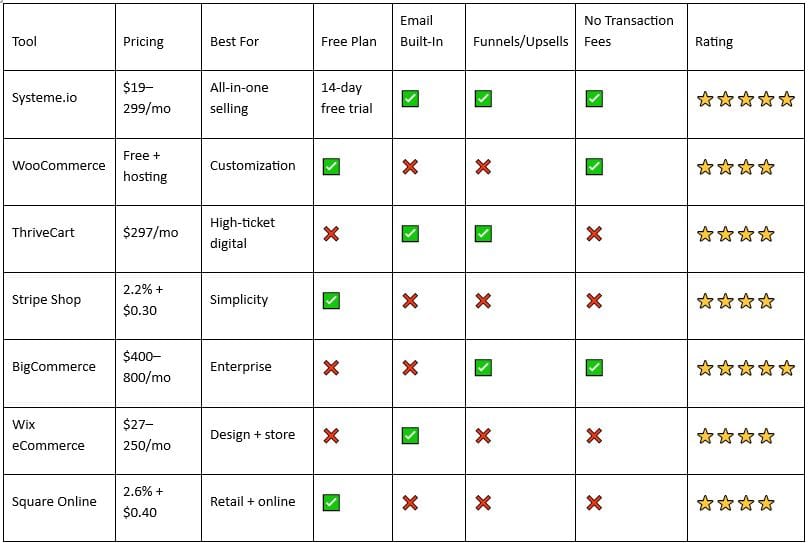
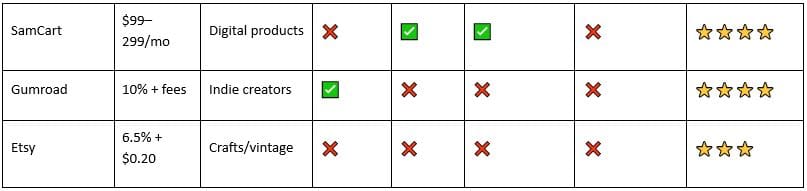
Which Alternative Is Right for You?
If you want everything in one place (and hate paying for 5 different tools):
Go with Systeme.io. It's the only platform that bundles funnels, email, landing pages, store, and courses without monthly app stacking. Plus, zero transaction fees means you keep more of every sale.
If you're a developer or need unlimited customization:
Choose WooCommerce. You'll invest time in setup, but you own everything. Perfect if you need features no other platform offers.
If you're selling expensive digital products ( 100+):
Pick ThriveCart .The flat 297/month fee is actually cheaper than Shopify + email + upsell platform once you're doing serious volume. Built for consultants and course creators.
If you want the absolute cheapest way to start selling:
Start with Stripe Shop (free to set up, pay only on sales) or Gumroad (10% fees, minimal overhead). These are perfect for testing ideas with zero risk.
If you're a large retailer or B2B seller:
Invest in BigCommerce. No transaction fees, wholesale features, and enterprise tools justify the $400+/month price tag.
If you're a designer or want a beautiful site:
Use Wix eCommerce. You'll pay more, but the design quality and ease of use are unmatched for creatives.
If you have both in-store and online sales:
Use Square Online. Unified inventory across channels is worth it alone.
If you're selling independent digital creative work (books, music, art):
Use Gumroad. Nothing's simpler or more creator-focused. 10% is fair.
If you're selling handmade or vintage items:
Use Etsy. The traffic and buyer intent offset the higher fees.
Why Thousands Are Making the Switch in 2026
Shopify was revolutionary in 2010. But it's 2026 now.
The market has matured. Hundreds of platforms now do what Shopify does—but better, cheaper, or more specialized. Shopify's response? Keep raising prices. They've hiked fees 7 times since 2020.
Meanwhile, alternatives like Systeme.io are actually lowering costs and adding features. The economics have flipped.
Here's the truth: You don't need Shopify anymore. You need a platform that matches your business model, your budget, and your ambitions. That platform might be Systeme.io. It might be WooCommerce. It might be Etsy.
The point is: you have options. Real, viable, better options.
The Bottom Line: Systeme.io Is the Clear Winner for Most Businesses
If you're looking for one recommendation:
Systeme.io is the best overall Shopify alternative because it eliminates the problem that makes people leave Shopify in the first place: fragmentation and cost.
You get:
✅ All-in-one platform (no app patchwork)
✅ Zero transaction fees (save 2.9% + $0.30)
✅ Built-in email marketing (save $30–100/month)
✅ Professional funnels (save another $100/month)
✅ One pricing tier that scales (no surprise bills)
For a business doing 10,000/month,that′s 3,500+ in annual savings. And you spend less time managing apps.
Ready to Make the Switch?
Systeme.io gives you everything Shopify does—and everything Shopify doesn't. Start selling your way, not Shopify's way.
14-day free trial. Full access. No credit card required.
Once you see what it's like to sell without transaction fees, without app subscriptions, and with real funnel power... you'll wonder why you waited this long.
FAQ: Shopify Alternatives Answered
What is the best free alternative to Shopify?
Stripe Shop and Gumroad are truly free to set up. You only pay when you make a sale. WooCommerce is also free (plugin), though you need hosting ($100–300/year).
Why are people leaving Shopify in 2026?
Three reasons: (1) Rising fees — Shopify has increased transaction fees 7 times since 2020. (2) Feature bloat — You pay for features you'll never use. (3) Hidden costs — Apps, email marketing, and funnels add hundreds monthly. Alternatives like Systeme.io offer better value.
Is Systeme.io better than Shopify?
For most small-to-mid businesses: yes. Systeme.io costs less ( 19–299/monthvs.Shopify′s 29–2,300 + app overages), includes email + funnels (saving $100–200/month), and has zero transaction fees. Shopify is better only for massive retailers needing advanced enterprise features.
Can I switch from Shopify without losing my customers?
Yes. Export your customer list from Shopify (do this first), import email list to your new platform, and update your domain DNS to point to the new store. Most migrations take 1–2 days. Plan it carefully, and zero downtime is possible.
Which alternative has the lowest fees?
Gumroad (10% + payment processor) and Stripe Shop (2.2% + $0.30) have the lowest transaction fees. Systeme.io has zero transaction fees (you only pay the payment processor), making it the best for total cost.
Is WooCommerce cheaper than Shopify long-term?
Yes, if you can manage it yourself or hire a developer once. WooCommerce is free (plugin) + hosting ( 100–300/year). But once you add premium plugins, security, backups, and updates, it can creep to 300+/year. Shopify + apps often exceeds this, making WooCommerce cheaper—but requires more work.
This post contains affiliate recommendations and links. I only promote products and services I personally use, trust, and believe will genuinely benefit my audience. If you purchase through my links, I may earn a commission at no extra cost to you. This compensation helps support my work and allows me to continue providing valuable content. Thank you for your support and trust.
Leave a reply

Let’s Collaborate To Grow
Your Dream Results Are Closer Than You Think.
Ready to take the next step? Book a free chat, and let's discuss how we can work together to achieve your goals. In the meantime, please complete the "Collaboration Interest Form" so we can create a collaboration that aligns with your interests.
Remember, building a successful business doesn't have to be a solo journey. At nuBeginning, we're committed to providing you with the tools, resources, and support you need to turn your entrepreneurial dreams into reality.
eCommerce Your Digital Products with Ease!


Useful Links


Copyright © 2022 SuePats.com - nuBeginning.com | All Rights Reserved | PRIVACY POLICY - TERMS & CONDITIONS - DISCLAIMER