
Systeme.io: The Lean Solopreneur's All-in-One Review
Systeme.io: The Lean Solopreneur's All-in-One Review
The 2026 Solopreneur Pivot: Why the "Franken-stack" is Dying and How Systeme.io is Eating the Market
Get Premium eCourses Package for FREE: https://www.nubeginning.com/plr-package
Free Funnel Certification: https://tinyurl.com/Funnel-Certification
Free All-in-one Platform trial: http://tinyurl.com/Systeme4u
1. The Solopreneur’s "Franken-stack" Problem
In the early days of the creator economy, building a digital business required a "Franken-stack"—a precarious assembly of disconnected SaaS tools. You had one platform for email, another for sales pages, a third for course hosting, and a separate payment processor, all held together by the digital equivalent of duct tape: Zapier. For the modern solopreneur, this isn't just a billing headache; it is a source of significant technical debt and data silos .By 2026, the strategic landscape has shifted. The most successful founders are realizing that juggling four different logins and troubleshooting API failures between their funnel and their autoresponder is a massive drain on their "speed to market." Every disconnected tool creates a friction point that increases your Customer Acquisition Cost (CAC) and obscures your data attribution.The trend is clear: the industry is moving toward "unified engines." Solopreneurs are abandoning complex, expensive stacks in favor of single, streamlined dashboards. The goal is no longer to own the "best-in-breed" tool for every micro-task, but to achieve a unified infrastructure that maximizes execution speed.
2. The Viability of the $0 Digital Business
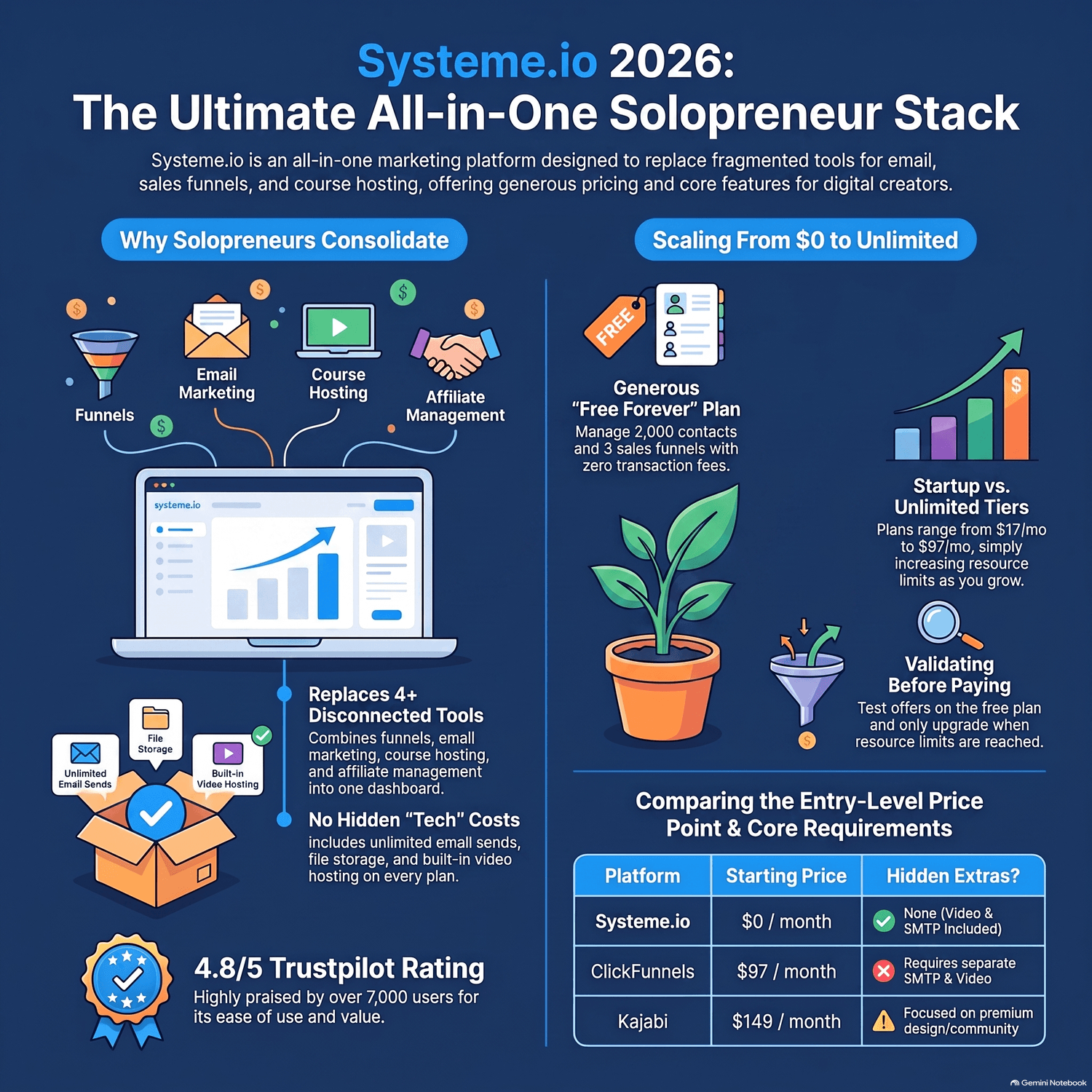
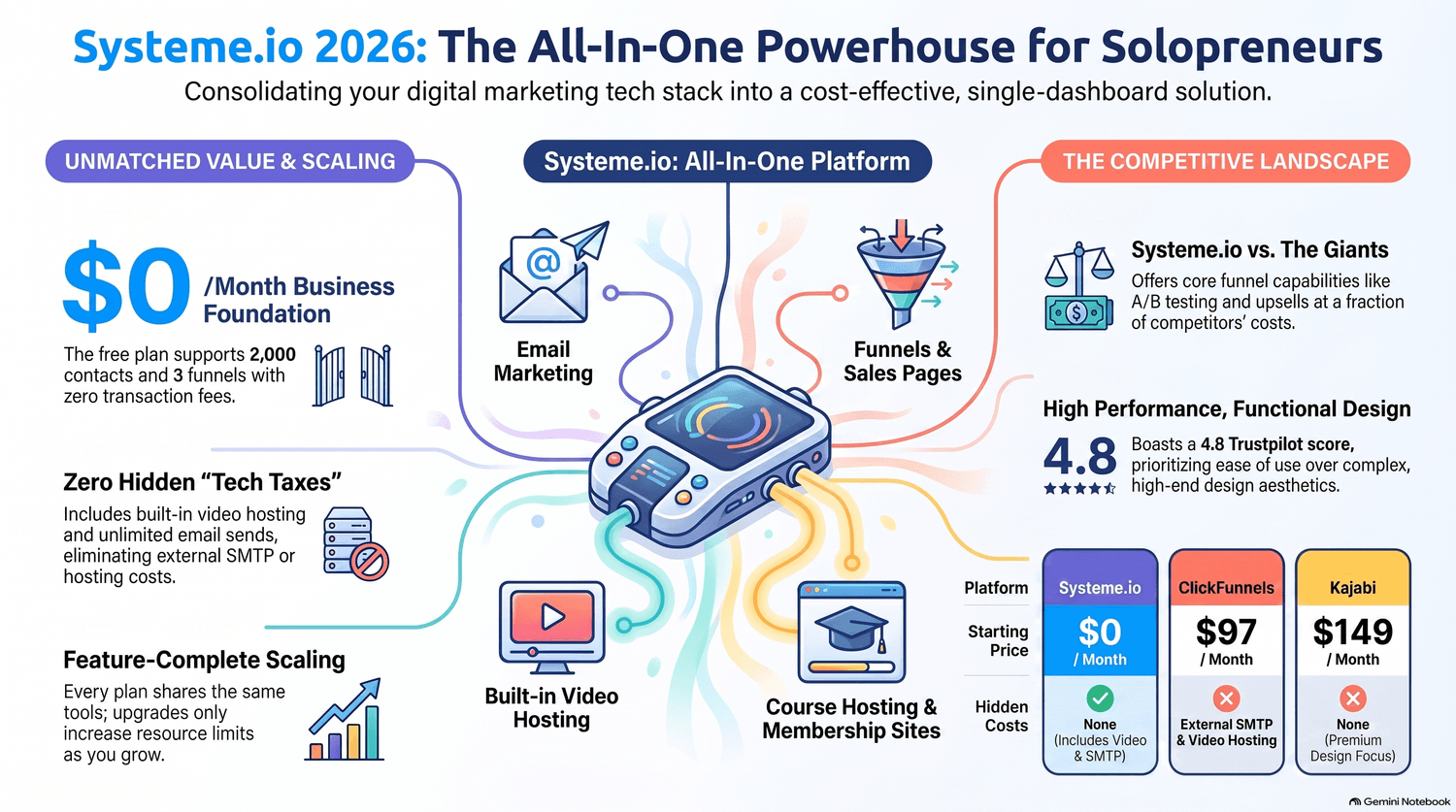
From a SaaS analyst's perspective, Systeme.io’s free tier is a masterclass in market validation metrics . While many "free" plans are merely stripped-down trials, this configuration provides a genuine "zero-CAC runway" for a new offer. The limits are strategically chosen: 2,000 contacts, 3 sales funnels, 1 course, and—crucially— 1 automation rule .This single automation rule is the technical linchpin. It allows a creator to build a fully automated bridge between a lead magnet and a delivery sequence. With these resources, a solopreneur can host a list-building funnel, a primary sales page, and a product delivery sequence without any initial overhead. By removing the "financial excuse" for inaction, Systeme.io has commoditized the launch phase, allowing users to validate the unit economics of their business before committing to a subscription.
3. The "Hidden Tech Tax" of Premium Competitors
While legacy platforms like ClickFunnels highlight their features, they often ignore the "hidden tech tax" inherent in their architecture. For example, ClickFunnels frequently requires users to source external SMTP providers for email delivery and pay for third-party video hosting. When you factor in these additional line items, the real cost of operation can balloon by an extra $50 to $100 per month.Systeme.io eliminates these hidden costs by providing native infrastructure. Unlimited email sends, unlimited file storage, and built-in video hosting are included even on the entry-level tiers. As the source context aptly notes:"For lean operations watching every line item, that gap compounds fast."When video and email infrastructure are natively integrated, the platform isn't just a cost-saver—it’s a moat against technical complexity. Centralizing these services prevents the "integration tax" that typically plagues multi-vendor stacks.
4. A Radical Approach to Pricing Tiers
Most SaaS companies use "feature-gating" to force users into higher-priced tiers, locking essential tools like A/B testing or affiliate management behind expensive paywalls. Systeme.io has taken a counter-intuitive approach to tier structure: every plan, from the $0 Free tier to the $97/month Unlimited plan, shares the exact same feature set.In this model, upgrading is strictly a function of resource limits (contacts, funnels, or automation rules) rather than "unlocking" capability. This is exceptionally consumer-friendly because it allows a founder to fully pressure-test the platform’s entire ecosystem—including the affiliate engine and automation workflows—before spending a dollar. It represents a shift toward a more transparent, usage-based SaaS economy.
5. Why "Perfect Design" is the Enemy of Validation
A common critique from design purists is that all-in-one platforms lack the "polish" of specialized tools like Kajabi. Furthermore, Systeme.io lacks SCORM support , a dealbreaker for corporate L&D (Learning and Development) environments.However, from a strategic standpoint, this is a feature, not a bug. By ignoring the corporate sector, Systeme.io remains a "solopreneur-first" tool. For those in the validation phase, "functional-but-not-flashy" is often the superior choice because it prevents the "perfectionism trap."This approach pairs perfectly with ready-to-sell assets. For instance, digital product bundles from NuBeginning are delivered as standard digital files compatible with Systeme.io’s upload formats . This means a solopreneur can acquire a high-quality product, upload it to their dashboard, and have a functional storefront live within hours. In 2026, the market rewards the fast, not just the flashy.
6. Instant Scalability via Built-in Affiliates
Transitioning from a "solo-seller" to a managed team typically involves a nightmare of API integrations and third-party affiliate software. Systeme.io’s inclusion of a native affiliate program on every tier—including the free plan—is a significant strategic advantage.By keeping the affiliate engine internal, the platform removes the "API friction" that often causes tracking errors in more complex setups. This allows a solopreneur to recruit partners to promote their digital products from day one. It’s a path to instant scalability that doesn't increase the technical overhead of the business, turning a solo operation into a distribution powerhouse with zero additional software costs.
7. The Verdict: Who Should Switch and Who Should Stay?
With a 4.8 Trustpilot rating serving as a strong market validation metric, the data suggests that user satisfaction is tied directly to the platform's focus on simplicity. Here is the analytical breakdown:
The Ideal User: Lean solopreneurs, coaches, and creators selling digital products or memberships. If your priority is reducing technical debt and consolidating your billing into a single, predictable line item, this is the premier choice.
The "Keep Looking" User: Enterprise-level businesses requiring complex CRM pipelines, those who need SCORM compliance for corporate training, or brands whose entire value proposition is built on high-end, bespoke student interfaces.
8. Conclusion: Your Move in the 2026 Economy
The era of the "Franken-stack" is over. The technical barriers to entry for digital business have not just been lowered; they have effectively collapsed. You no longer need to manage four separate bills and three different data silos to keep your storefront open.By consolidating your funnels, email marketing, and course hosting into a single dashboard, you can finally shift your focus from "fixing the tech" to "finding the customer." As you evaluate your current overhead, ask yourself: What is the true cost of technical complexity versus the speed of implementation?In the high-velocity market of 2026, the founders who win are those who choose the shortest path to a live offer. Your infrastructure should be an engine, not an anchor.
Study Guide: Systeme.io Review 2026 Analysis
This study guide is designed to provide a comprehensive review of the features, pricing, and market positioning of Systeme.io as an all-in-one marketing platform. It focuses on its utility for solopreneurs and how it compares to industry competitors such as ClickFunnels, Kajabi, and Kartra.
Quiz: Understanding Systeme.io
Instructions: Answer the following questions in 2–3 sentences based on the information provided in the source context.
What specific resources are included in the Systeme.io Free plan?
How does the pricing philosophy of Systeme.io's paid tiers differ from many of its competitors?
What "hidden costs" associated with ClickFunnels are avoided by using Systeme.io?
What are the four pre-built funnel types available in the drag-and-drop builder?
How does the platform handle email marketing for high-volume senders?
What are the primary design and functional limitations of the course builder?
How can solopreneurs utilize "done-for-you" products like PLR or MRR within the platform?
What is the significance of the native affiliate program feature for new users?
According to the review, what are the reported weaknesses of the platform’s customer support?
In what business scenarios would Kajabi or Kartra be a better choice than Systeme.io?
Quiz Answer Key
What specific resources are included in the Systeme.io Free plan? The free plan provides 2,000 contacts, three sales funnels, one course, and one automation rule. It also includes one custom domain and unlimited email sends with zero transaction fees, though the pages will feature Systeme.io branding.
How does the pricing philosophy of Systeme.io's paid tiers differ from many of its competitors? Unlike other platforms that unlock new tools as users upgrade, all Systeme.io plans share the same feature set. Upgrading to higher tiers like Startup, Webinar, or Unlimited simply increases the resource limits for contacts, funnels, and courses.
What "hidden costs" associated with ClickFunnels are avoided by using Systeme.io? ClickFunnels often requires users to pay for an external SMTP provider for emails and separate video hosting services. Systeme.io includes unlimited email sends, unlimited file storage, and built-in video hosting on every plan, including the free tier.
What are the four pre-built funnel types available in the drag-and-drop builder? The builder offers specialized sequences for lead generation, sales, evergreen webinars, and product launches. These templates allow solopreneurs to build functional funnels without needing coding skills or starting from a blank canvas.
How does the platform handle email marketing for high-volume senders? While the built-in sender is sufficient for typical volumes, high-volume senders can connect a dedicated SMTP provider like SendGrid to reduce spam filter risks. The platform also supports native connections or Zapier integrations for external tools like ActiveCampaign or GetResponse.
What are the primary design and functional limitations of the course builder? The course builder lacks support for SCORM and has a design aesthetic that is less polished than premium competitors like Kajabi. It also lacks advanced student experience features such as sophisticated assessments, certificates, and a custom community interface.
How can solopreneurs utilize "done-for-you" products like PLR or MRR within the platform? Users can upload standard digital files from PLR (Private Label Rights) or MRR (Master Resell Rights) bundles directly into the course builder and product pages. This allows a solopreneur to establish a functional storefront and sales funnel for these products within a single day.
What is the significance of the native affiliate program feature for new users? The built-in affiliate program is available even on the free plan, allowing users to recruit others to promote their digital products immediately. This removes the need for a separate affiliate management tool and simplifies the scaling of marketing efforts.
According to the review, what are the reported weaknesses of the platform’s customer support? Support is limited to chat and email with no phone option, and response times can vary significantly from one hour to nearly 19 hours during peak traffic. Additionally, ticket continuity can be inconsistent if different agents handle the same thread.
In what business scenarios would Kajabi or Kartra be a better choice than Systeme.io? Kajabi is preferable for brands requiring a premium student experience and high-end visual design for courses. Kartra is a better fit for complex businesses that need advanced CRM pipelines and intricate marketing automation sequences that exceed Systeme.io's basic capabilities.
Essay Questions
Instructions: These questions are designed to encourage deeper analysis of the platform's role in the digital marketing ecosystem. (No answers provided).
The Value of Consolidation: Discuss the advantages and disadvantages of using an "all-in-one" platform versus a "best-of-breed" stack for a solopreneur starting a digital product business.
Evaluating the Free Model: Analyze how Systeme.io’s generous free plan functions as a market-disruption strategy against established competitors like ClickFunnels and Kajabi.
Brand Identity vs. Functionality: Explore the trade-off between "functional-but-not-flashy" design and the needs of a growing digital brand. At what point does design polish become a necessity for a scaling business?
Strategic Scaling: Explain the "lowest-risk, highest-information" path suggested for validating a digital offer using Systeme.io. How does this approach protect a solopreneur's capital?
Feature Parity and Competition: Compare the core funnel-building capabilities of Systeme.io with ClickFunnels. Is the price difference justified by ClickFunnels' advanced analytics and larger template library for a typical solo founder?
Glossary of Key Terms
Term,Definition
A/B Testing,A native feature that allows users to compare two versions of a page to determine which performs better for conversions.
Affiliate Program,A system where third parties promote a product in exchange for a commission; managed natively within Systeme.io.
Automation Rule,"A trigger-based action (e.g., an opt-in or purchase) that initiates a specific marketing workflow."
Custom Domain,"A personalized web address that can be connected to a Systeme.io account, even on the free plan."
Drip-Release Content,A course delivery method where content is released to students gradually over time rather than all at once.
Evergreen Webinar,An automated webinar funnel designed to run continuously without the need for a live presenter.
Lead Magnet,A free offer (like a PDF or video) used to capture contact information from potential customers.
MRR / PLR,"Master Resell Rights and Private Label Rights; ""done-for-you"" digital products that can be rebranded and sold."
One-Click Upsell,A feature that allows customers to add an additional product to their purchase with a single click after their initial transaction.
Order Bump,An offer presented on the checkout page to encourage customers to add a complementary item to their cart.
SCORM,A set of technical standards for e-learning software; notably not supported by the Systeme.io course builder.
SMTP Provider,A service used for sending emails (Simple Mail Transfer Protocol); Systeme.io includes this natively but allows external connections.
Zero Transaction Fees,"A policy where the platform does not take a percentage of the user's sales revenue, applicable across all pricing tiers."
Get Premium eCourses Package for FREE: https://www.nubeginning.com/plr-package
Free Funnel Certification: https://tinyurl.com/Funnel-Certification
Free All-in-one Platform trial: http://tinyurl.com/Systeme4u
Leave a reply
Copyright © 2022 SuePats.com - nuBeginning.com | All Rights Reserved | PRIVACY POLICY - TERMS & CONDITIONS - DISCLAIMER