
Beyond Teachable: The 10 Best Course Platforms for 2026
Beyond Teachable: The 10 Best Course Platforms for 2026
Get Premium eCourses Package for FREE: https://www.nubeginning.com/plr-package
Free Funnel Certification: https://tinyurl.com/Funnel-Certification
Free All-in-one Platform trial: http://tinyurl.com/Systeme4u
Beyond Teachable: The 10 Best Course Platforms for 2026
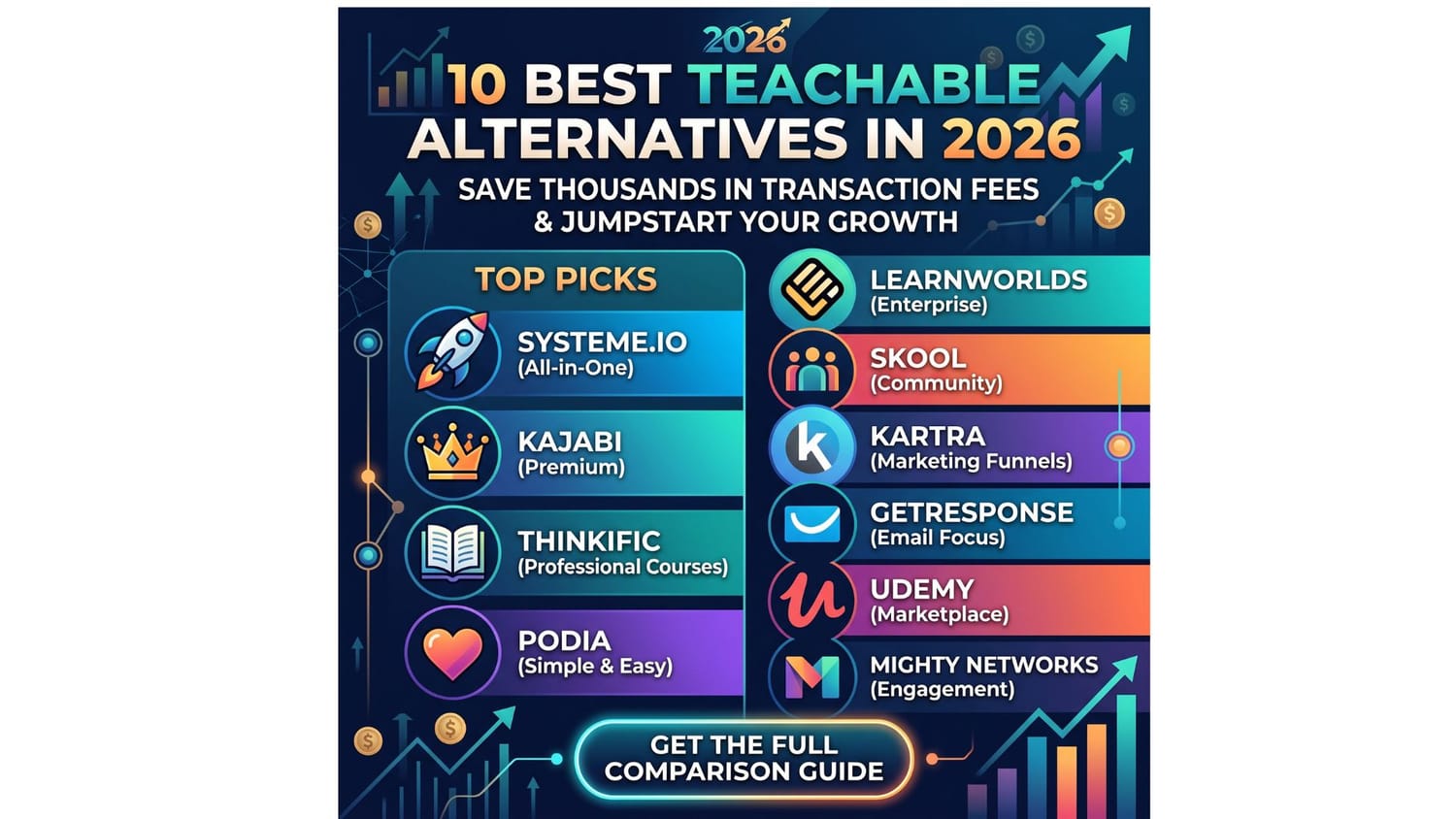
This guide highlights several leading alternatives to Teachable for online course creators seeking to avoid high transaction fees and fragmented software tools. It primarily identifies Systeme.io as a top all-in-one solution that integrates email marketing, sales funnels, and webinars with zero added costs per sale. Other options include Kajabi for high-end branding, Thinkific for professional education requirements, and Podia for those prioritizing a quick, simple setup. The text emphasizes that switching to these modern platforms can save businesses significant revenue while providing superior automation and community features. Ultimately, the source serves as a strategic roadmap for creators to maximize their profits by selecting a platform tailored to their specific business model.
The $150,000 Platform Tax: Why Course Creators are Fleeing Teachable in 2026
The "Success Tax" is a Measurable Threat to Your 2026 Margins
In the current digital economy, the most dangerous illusion is that higher revenue equals higher freedom. Many creators are finding that as they scale, their profit margins are actually shrinking, consumed by a "platform tax" that rewards the provider while penalizing the entrepreneur. Success should not be a liability. If your growth leads to diminishing returns, you aren't building an asset; you’re financing someone else’s. Teachable, once a pioneer in the space, has evolved into a financial bottleneck in 2026. For a high-performing creator, staying on a legacy platform is no longer a matter of convenience—it is a strategic error that costs six figures in lost capital annually.
Percentage-Based Fees are a Structural Tax on Scaling, Not a Service Cost
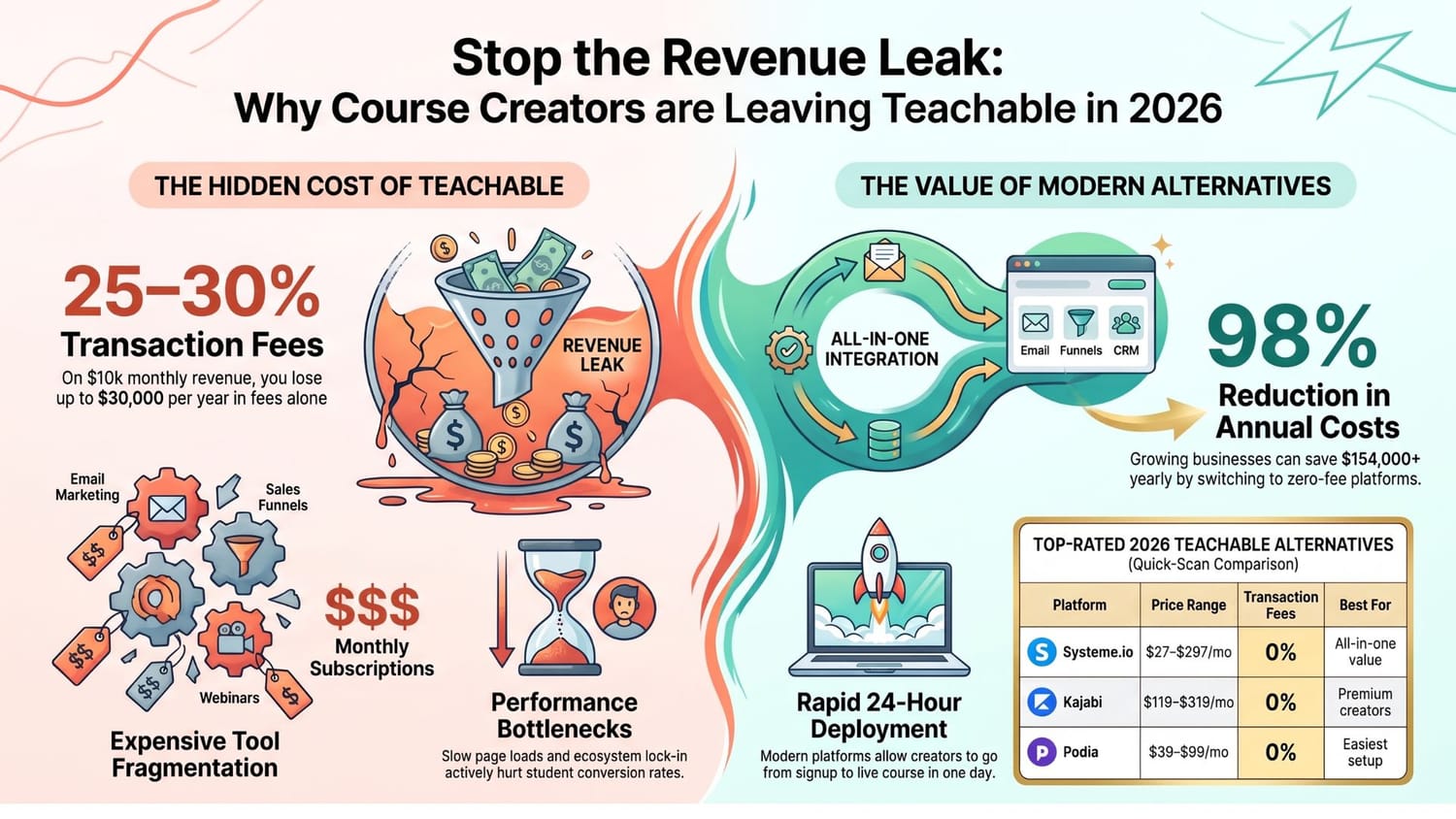
The traditional SaaS model is built on flat fees for service, but Teachable’s 25–30% transaction fee structure functions as a "silent partner" in your gross revenue. This is a structural tax on success. The more value you create, the more you are penalized. While a flat subscription fee is a manageable cost of goods sold, a percentage-based fee is a drain on your scalability.To understand the magnitude of this, look at the "Scenario #2" reality for a growing business generating $50,000 per month. On Teachable, once you factor in the 25% transaction fees and the mandatory third-party "duct-tape" tools like ConvertKit and Zoom, the annual cost of doing business reaches $ 156,999. Compare this to an all-in-one alternative like Systeme.io, which charges zero transaction fees and includes those tools for a total annual cost of $2,364 ."I was paying Teachable $99/month + 30% on every course sale. With 200 enrollments/month at $297 per course, I was losing $18,000 in transaction fees alone. Switched to Systeme.io for $97/month with zero fees. I'm saving nearly $200,000 per year — while getting better email and funnel tools." — James M., Course Creator
Fragmentation is a Technical Debt That Cannibalizes Your Operational Efficiency
The "Ecosystem Lock-In Problem" is not an accident; it is a predatory design choice. Teachable operates as a walled garden that lacks native marketing infrastructure, forcing creators into a state of Tool Fragmentation . This requires you to pay for and manage separate subscriptions for email (Mailchimp or Klaviyo), funnels, and webinars.Fragmentation creates a hidden "Complexity Tax." Beyond the $31,000 to $466,000 in additional tool costs identified in recent market data, the operational friction of manual data syncing and siloed student information creates significant technical debt. All-in-one platforms are disrupting this by consolidating the entire value chain—from lead capture to course delivery—into a single dashboard, replacing 5+ separate subscriptions with one unified workflow.
Speed to Market is Your Only Hedge Against Industry Volatility
In 2026, the cost of delay is often higher than the cost of development. Legacy platforms like Thinkific or Kajabi typically require a 1-to-2-week setup period to reach full optimization. In a volatile market, this "setup friction" is a barrier to entry. Modern tools have democratized technical execution by prioritizing speed.Platforms like Systeme.io and Podia have redefined the industry standard, allowing for launches in 24 hours and 30 minutes, respectively. This isn't just about convenience; it’s about agility. The ability to move from an idea to a live, revenue-generating product in a single day allows creators to test markets faster and pivot without the heavy overhead of long development cycles.
Engagement is the Primary Driver of Student LTV and Completion Rates
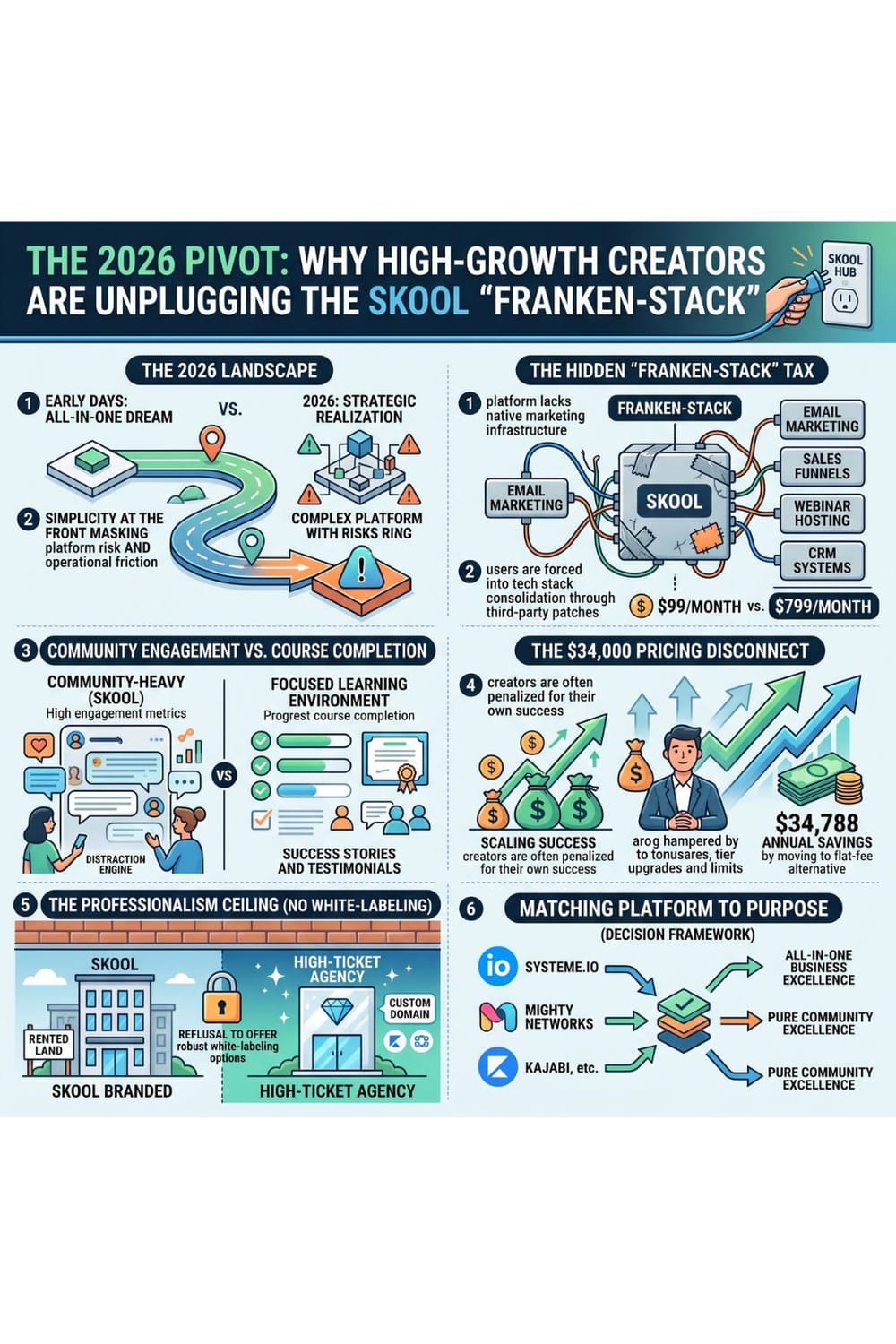
The "isolated content library" model is dead. In 2026, creators have realized that the best learning happens in conversation, not through passive consumption. Community-first platforms like Skool and Mighty Networks are the new industry gold standard. By integrating peer interaction directly into the learning experience, these platforms solve the completion rate crisis.Peer interaction is a value multiplier. When students engage with each other, the Lifetime Value (LTV) of the customer increases because the community itself becomes the product. This shift from "content as king" to "community as the core" ensures that students aren't just buying information—they are buying transformation through engagement.
The Marketplace Model is a High-Cost Loan Against Your Brand Equity
Marketplace models like Udemy present a "Udemy Paradox" where the promise of free distribution comes at the cost of your business's soul. While the visibility gain is undeniable, it is a trade-off that rarely favors the creator in the long term. Marketplaces offer distribution at the expense of control and margins.
The Visibility Gain: Immediate access to 18+ million students and built-in trust.
The Revenue Loss: A model where you lose 50–75% of every sale, frequently yielding only $24.75 on a $99 course.Crucially, Udemy controls your pricing , often discounting your hard work to $10–$ 15 without your consent. Furthermore, you cannot export student data. This creates a state of total dependency where you are a tenant, not a landlord, of your own intellectual property.
Alignment, Not Popularity, Dictates Your 2026 Tech Stack
Finding the right platform is an exercise in strategic alignment. Use this framework to identify where your business needs to reside based on your specific ROI requirements:
Choose Systeme.io for All-in-One Value: The definitive choice for those seeking to eliminate transaction fees and consolidate email, funnels, and courses into one $0-transaction-fee dashboard.
Choose Kajabi for Premium Branding: Optimized for creators charging $500+ who require a high-end, polished student experience and have the budget for a premium ecosystem.
Choose Podia for Ultimate Simplicity: The path of least resistance for solo creators who need to go from signup to live in 30 minutes.
Choose Skool or Mighty Networks for Community-Driven Learning: Best for cohort-based programs where peer interaction is the primary value proposition and completion driver.
Choose Thinkific for Professional Flexibility: The standard for organizations requiring SCORM compliance, complex course branching logic, and developer-level API access.
Inaction is the Most Expensive Line Item on Your Balance Sheet
The online education landscape in 2026 has no room for legacy sentimentality. The platforms that helped you start are often the ones preventing you from scaling. While migration is "deliberately painful" by design, you must view it through the lens of ROI. A 20-hour investment in migration can yield a six-figure return.The financial upside of switching is no longer theoretical; it is a mathematical certainty. Every month you delay is a month you are paying a heavy success tax to a platform that is no longer your partner.Is your current platform a partner in your growth, or a silent partner in your profits?
Comprehensive Study Guide: Online Course Platforms and Teachable Alternatives (2026)
This study guide provides a detailed analysis of the online course platform landscape in 2026, focusing on the shift away from traditional hosting services toward all-in-one and specialized alternatives. It examines cost structures, feature sets, and strategic decision-making for digital creators.
Part 1: Review Quiz
Instructions: Provide short-answer responses (2–3 sentences) for each of the following questions based on the source context.
What are the primary reasons cited for creators migrating away from Teachable in 2026? The main drivers for migration are Teachable’s high transaction fees (25–30%) and its "walled garden" ecosystem, which lacks integrated marketing tools like sales funnels and email. Additionally, creators cite slow page load times and the high cost of maintaining separate tools for webinars and affiliate management.
How does the financial impact of transaction fees change as a creator’s revenue grows? Transaction fees act as a "structural tax" that scales directly with success, meaning higher earnings result in significantly higher losses. For example, a business earning $150,000 monthly would lose $37,500 every month to Teachable's fees, whereas a flat-rate platform like Systeme.io would cost only $297 per month regardless of volume.
What defines Systeme.io as an "all-in-one" business platform? Unlike platforms that focus exclusively on course hosting, Systeme.io integrates course delivery with a full suite of marketing tools including email marketing, sales funnels, and a CRM. It aims to eliminate tool fragmentation by providing webinars, affiliate management, and automation within a single dashboard for a flat monthly fee.
Why is Kajabi considered the best choice for "premium" creators? Kajabi is designed for creators charging $500 or more per course, offering high-end student interfaces and polished, professional templates that reflect a high brand value. Its ecosystem includes advanced automation and membership tools specifically crafted for those building established, high-revenue digital businesses.
What specific features make Thinkific suitable for corporate and professional training? Thinkific offers advanced educational structural flexibility, including SCORM/xAPI compliance, graded assignments, and course prerequisites. It also provides CSS/HTML editing and API access, which are critical for organizations and developers who need to meet specific corporate branding and compliance requirements.
How does Podia differentiate itself from more complex marketing-heavy platforms? Podia positions itself as the "simplicity champion," allowing users to launch a professional-looking course in approximately 30 minutes. It avoids the "configuration rabbit holes" found in feature-heavy platforms by offering a clean, modern aesthetic and a unified dashboard that prioritizes ease of use over complex automation.
What are the significant trade-offs involved in using the Udemy marketplace model? While Udemy provides immediate access to over 18 million students and handles all marketing, the instructor loses significant control and revenue. Udemy takes 50–75% of every sale, controls the pricing (often discounting courses to $10–15), and prevents instructors from exporting student email addresses to build their own lists.
In what way do Skool and Mighty Networks prioritize community over content delivery? These platforms are "community-first," meaning they integrate discussion forums directly into lessons and use features like activity feeds, member-to-member messaging, and gamification. They are designed on the premise that peer interaction and engagement are as valuable to student success as the course content itself.
What marketing-specific advantages does Kartra offer to digital product sellers? Kartra provides a highly sophisticated funnel builder that includes one-click upsells, downsells, and abandoned cart recovery. Its automation engine is built for "creators who think like marketers," offering behavioral triggers for emails and advanced funnel analytics to optimize conversions.
What logistical hurdles should a creator expect when migrating from Teachable to a new platform? Migrating is described as a "deliberately painful" process that requires manual work, typically taking 8 to 20 hours depending on the complexity of the course. While student data (CSV) and course content (ZIP) can be exported, everything must be re-uploaded and reconfigured on the new platform.
Part 2: Quiz Answer Key
Primary reasons for migration: Transaction fees of 25–30%, tool fragmentation (needing separate apps for email/funnels), slow page loads, and "ecosystem lock-in."
Financial impact of fees: Fees scale with success; a $10k/month creator loses ~$ 30k/year, while a $150k/month creator loses over $460k/year compared to flat-fee alternatives.
Systeme.io definition: It combines course hosting with email, sales funnels, landing pages, webinars, and CRM in one dashboard with zero transaction fees.
Kajabi for premium creators: It focuses on high-value aesthetics, white-labeling, and a high-end student experience for those charging $500+ per course.
Thinkific corporate features: SCORM/xAPI compliance, advanced quiz builders, assignment grading, and developer-level access via API/CSS.
Podia's differentiation: Extreme ease of use, 30-minute setup, no technical skills required, and a "clean" interface without complex decision fatigue.
Udemy trade-offs: You get instant exposure to 18M students but lose 50–75% of revenue, lose control over pricing, and cannot build an independent email list.
Community-first platforms: They focus on peer-to-peer learning, discussion-embedded lessons, and real-time engagement rather than isolated video libraries.
Kartra advantages: Advanced funnel logic (upsells/downsells), behavioral-based email triggers, and professional templates optimized for revenue growth.
Migration hurdles: Manual re-uploading of content, reconfiguration of settings, and roughly 8–20 hours of labor, despite being able to export basic data.
Part 3: Essay Questions
Economic Analysis: Evaluate the long-term financial consequences of transaction-based pricing versus subscription-based pricing for a scaling digital business. Use the cost scenarios provided for $10,000, $50,000, and $150,000 monthly revenues to support your argument.
Platform Philosophy: Compare the "All-in-One" philosophy (e.g., Systeme.io, Kajabi) with the "Specialized" philosophy (e.g., Skool for community or Thinkific for professional education). Which approach is more sustainable for a solo creator versus a large corporation?
The Evolution of Learner Engagement: Discuss how platforms like Skool and Mighty Networks are changing the definition of online education from "content consumption" to "community-driven learning." What are the benefits and potential distractions of this model?
Strategic Migration: Analyze the concept of "Ecosystem Lock-In" mentioned in the text. How do platforms create exit barriers, and at what point does the cost of staying (the "Teachable tax") outweigh the labor-intensive cost of migrating to a new system?
Marketplace vs. Self-Hosted: Assess the viability of Udemy for Business as a "validation tool" for new instructors. Compare this to the benefits of owning the customer relationship on a platform like Podia or Systeme.io.
Part 4: Glossary of Key Terms
All-in-One Platform: A software solution that combines multiple business functions—such as course hosting, email marketing, sales funnels, and CRM—into a single dashboard to eliminate the need for third-party tools.
CRM (Customer Relationship Management): Tools used to manage and analyze student interactions and data throughout the customer lifecycle, included in platforms like Systeme.io and Kartra.
Cohort-Based Learning: An educational model focusing on groups of students moving through a course together, often facilitated by community-heavy platforms like Skool.
Drip Content: A feature that releases course lessons gradually over time rather than all at once, used to manage student progress.
Ecosystem Lock-In: A strategic situation where a platform makes it difficult or "painful" for a user to switch to a competitor by creating barriers to data migration and requiring separate tools for basic functions.
Gamification: The use of game-design elements—such as badges, points, and leaderboards—within a learning environment to increase student engagement (prominent in LearnWorlds and Mighty Networks).
Sales Funnel: A series of automated steps (landing pages, emails, upsells) designed to guide a potential student from initial awareness to a final purchase.
SCORM / xAPI: Technical standards for e-learning software that allow course content to be shared across different systems and provide advanced tracking of student data; essential for corporate training.
Tool Fragmentation: The inefficient state of using multiple, disconnected paid applications (e.g., one for email, one for courses, one for webinars) to run a single business.
Transaction Fee: A percentage of revenue taken by the platform on every sale, separate from the monthly subscription cost.
Upsell / Downsell: Marketing techniques where a customer is offered an additional, often more expensive product (upsell) or a cheaper alternative (downsell) during the checkout process.
White-Labeling: The ability to remove the platform's branding and replace it with the creator's own, making the service appear as a custom-built solution.
Get Premium eCourses Package for FREE: https://www.nubeginning.com/plr-package
Free Funnel Certification: https://tinyurl.com/Funnel-Certification
Free All-in-one Platform trial: http://tinyurl.com/Systeme4u
Leave a reply
Copyright © 2022 SuePats.com - nuBeginning.com | All Rights Reserved | PRIVACY POLICY - TERMS & CONDITIONS - DISCLAIMER