
Beyond Podia: Top 10 Creator Platform Alternatives for 2026
Top 10 Thinkific Alternatives and Course Platform Comparison Guide
Get Premium eCourses Package for FREE: https://www.nubeginning.com/plr-package
Free Funnel Certification: https://tinyurl.com/Funnel-Certification
Free All-in-one Platform trial: http://tinyurl.com/Systeme4u
Beyond Podia: Top 10 Creator Platform Alternatives for 2026
This text provides an in-depth comparison of various digital marketing platforms positioned as superior alternatives to Podia for the year 2026. It highlights specific shortcomings of Podia, such as its expensive pricing tiers, lack of advanced automation, and the absence of a built-in CRM or sales funnel builder. The guide identifies systeme.io as the premier choice for creators seeking a comprehensive all-in-one solution that offers more functionality at a lower cost. Other specialized tools are also categorized by their strengths, including Teachable for ease of use, Thinkific for advanced education, and Kajabi for high-budget operations. Ultimately, the source serves as a strategic roadmap for digital entrepreneurs looking to migrate to more efficient and cost-effective software ecosystems.
The Hidden Cost of Simplicity: Why 2026 is the Year of the Podia Exodus
1. Introduction: The Creator's Paradox
In the early days of a digital business, simplicity feels like a superpower. It allows you to ship products without getting bogged down in technical architecture. However, as 2026 unfolds, a growing segment of the market is hitting a structural ceiling. We call this the "Podia Paradox": the very user-friendly constraints that made the platform attractive during your launch phase have now become the primary bottlenecks preventing your scale.For many, leaving Podia feels like a breakup with a tool that "used to be enough." But as a creator strategist, I see the friction daily. When your business outgrows its infrastructure, "simple" quickly turns into "limiting," and "all-in-one" begins to feel like a cage. The exodus we are seeing isn't just about finding a new dashboard; it’s about creators reclaiming their ability to grow without being penalized by their own tech stack.
2. Takeaway 1: The "All-in-One" Tax (The Hidden $1,000+ Yearly Cost)
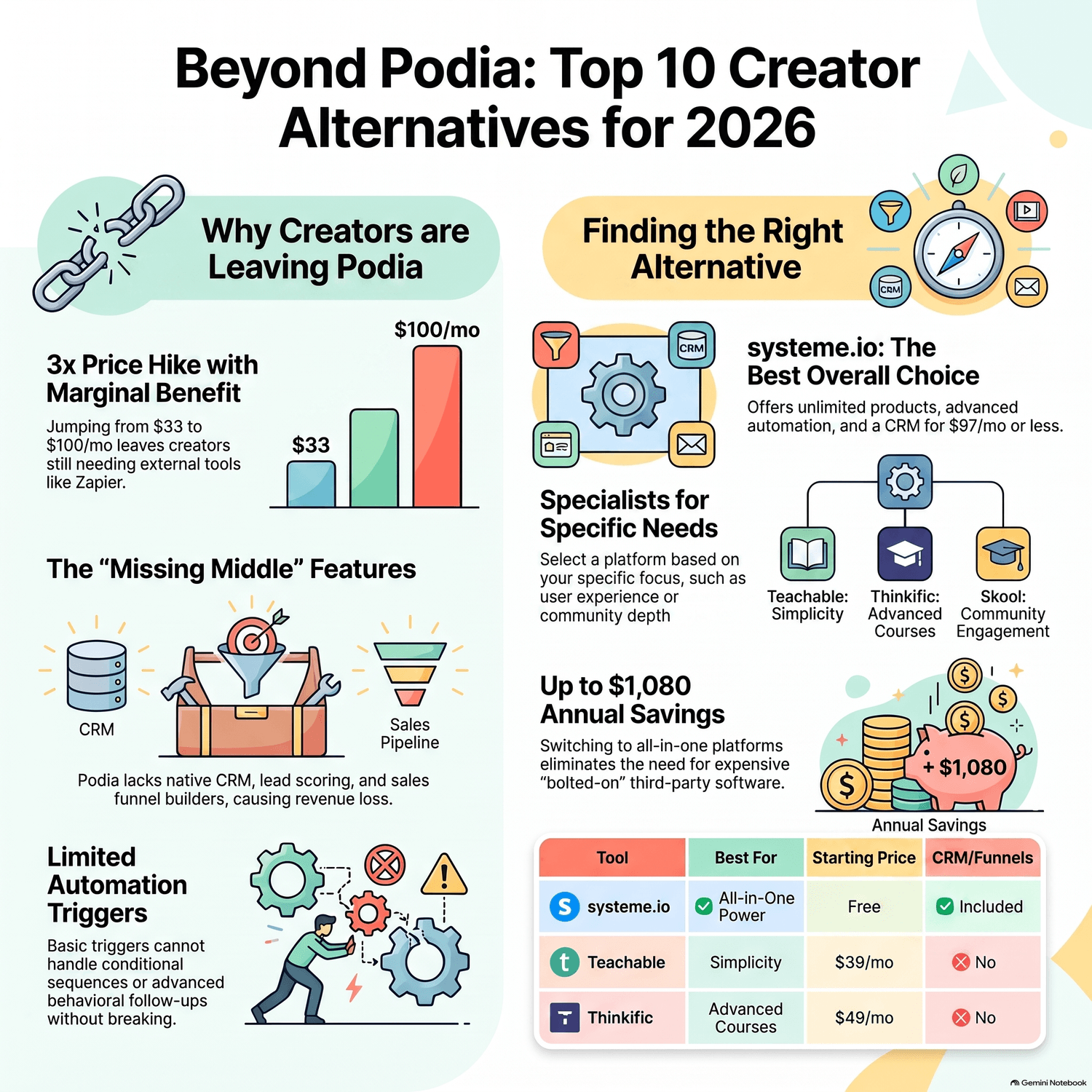
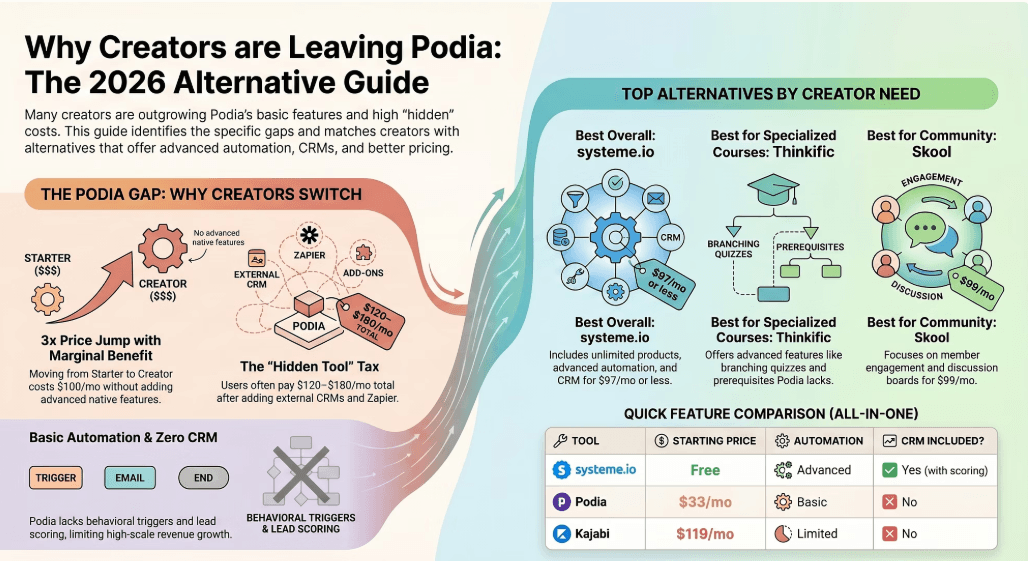
The most dangerous phrase in SaaS is "all-in-one," because it often masks significant tech debt . While Podia’s $100/month Creator plan marketed as a total solution, the reality for a scaling business is a fragmented, "bolted-on" infrastructure.Because Podia lacks advanced native automation and CRM depth, creators are forced to bridge the gap with third-party tools. This creates "tech stack fragmentation"—a fragile web of Zapier zaps and external CRMs that increases both your monthly overhead and your risk of system failure.The Real Cost of the Podia Stack: "When you add $25/mo for Zapier and $0–$ 50/mo for a CRM/lead tracking tool to the $100/mo Podia Creator base, your real cost climbs to $120–$ 180/mo. That is $1,440–$ 2,160/year for a stack that is still missing advanced course features."By "stitching" tools together, you aren't just paying more; you’re managing more. In 2026, the goal is native integration, not an expensive, manual workaround.
3. Takeaway 2: You’re "Flying Blind" Without Behavioral Data
In a competitive market, knowing "who bought what" is the bare minimum. To maximize Customer Lifetime Value (CLV) and mitigate churn, you need behavioral data. Podia effectively leaves you "flying blind" by offering no native CRM or lead scoring.Advanced alternatives like systeme.io have shifted the landscape toward proactive selling . Through built-in lead scoring—tracking email opens, link clicks, and specific course progress—you can identify "hot leads" before they even reach out. This allows for data-driven sales rather than passive hope. The strategic shift is massive: creators who have moved to platforms with native CRM capabilities report an average 25% conversion lift simply by executing smarter, behavioral-based follow-ups. If you aren't tracking how your students consume your content, you are leaving 2026 revenue on the table.
4. Takeaway 3: The 3x Price Jump Trap
From a financial autopsy perspective, Podia’s pricing model penalizes growth through arbitrary "feature walls." The transition from the $33/month Starter plan to the $100/month Creator plan represents a 3x price hike , yet the delta in actual utility is marginal.Compare this to the market disruptors. A competitor’s "Startup" plan at $27/month often includes 3,000 contacts and full automation workflows—features Podia gates behind its $100 tier. For a SaaS analyst, the verdict is clear: Podia is charging premium enterprise prices for mid-market capabilities. A sustainable business requires a tiered value system that scales with you, not a model that demands a 300% investment increase for basic professional features like affiliate management.
5. Takeaway 4: Simplicity vs. Serious Education (The Course Feature Gap)
As student expectations rise in 2026, "basic" course delivery has become a brand risk. When students pay for premium education, they expect professional learning paths, not just a list of videos. Podia lacks the "feature parity" required by serious educators, missing:
Branching Logic: To create personalized student journeys.
Completion Certificates: For formal student recognition.
Prerequisites: To ensure mastery before advancement.Platforms like Teachable and Thinkific have become the standard for those who prioritize the pedagogy of their brand. Relying on Podia's "simple" delivery in a saturated market signals to your students that your education is an afterthought, not a professional experience.
6. Takeaway 5: The "Systeme.io" Displacement
The primary driver of the Podia exodus is the rise of systeme.io as the "natural upgrade path." It has achieved dominance by outperforming Podia on 6 out of 11 critical metrics —offering more capability for less capital.Where the Displacement is Happening:
Automation: Advanced conditional sequences vs. Podia's basic triggers.
CRM: Integrated lead scoring vs. zero behavioral tracking.
Sales Funnels: Native lead-magnet-to-upsell builders vs. manual external stitching.
Course Features: Native quizzes and certificates vs. "basic" delivery.
Cost & Customization: Significantly higher value-per-dollar.The Analyst's Verdict: "I was paying $100 for Podia's Creator plan but only used 3 of 10 features. Meanwhile, I was missing automation and CRM that I actually needed. systeme.io included what I actually wanted and left out the fluff. Saved money and have 10x more capability ."
7. Takeaway 6: The 30-Day Migration Myth
Many creators remain in "Maintenance Mode" on Podia because they fear the migration process. However, a data-driven look at the timeline shows that a full transition can be executed in just 4 weeks.The 5-Step Migration Roadmap:
Week 1: The Audit (Critical Phase): Spend 1-2 hours documenting every product, email sequence, and customer segment. This prevents data loss.
Week 2: The Choice: Select your alternative based on your specific growth bottleneck.
Week 3: The Setup: Configure the new platform. For systeme.io, this typically takes only 4–8 hours .
Week 4: The Migration: Import data and re-enroll students. Crucial: Provide customers with at least 1 week’s notice to ensure a seamless transition.
Launch & Cancel: Point your domain, verify deliverability, and cancel your Podia subscription.
8. Conclusion: Is Your Tool Scaling With You?
In the 2026 creator economy, there is no room for tools that act as a ceiling. Podia remains a functional option for those in the "hobbyist" phase who prioritize a specific aesthetic over deep functionality. However, if you are moving into "Growth Mode," you must ask yourself: Is your platform an asset that accelerates your revenue, or is it tech debt that you’re constantly working around?"Good enough" tools are being replaced by specialized powerhouses. Don't let your 2026 goals be limited by a 2020 tech stack. It’s time to move from a tool that limits your vision to one that fuels your scale.
Study Guide: Evaluating Digital Product Platforms and Podia Alternatives (2026)
This study guide provides a comprehensive overview of the digital product platform landscape as of 2026, specifically focusing on the shift away from Podia toward more feature-rich or cost-effective alternatives. It includes a review quiz, essay prompts for deeper analysis, and a glossary of technical terms.
Review Quiz: Short Answer
1. Why is Podia’s "Creator" pricing tier often cited as a primary reason for user migration? The jump from the $33/month Starter plan to the $100/month Creator plan represents a 3x price hike with only marginal benefit. Furthermore, users often find they still need to pay an additional $45–$ 80/month for external tools like Zapier and a CRM because Podia lacks these advanced features natively.2. What distinguishes systeme.io’s automation capabilities from those offered by Podia? Systeme.io provides advanced automation that includes behavioral segmentation and sequences triggered by custom actions or course progress. In contrast, Podia’s automation is considered basic, lacking conditional sequences and requiring manual workarounds or third-party integrations.3. In the context of digital marketing platforms, what is lead scoring and why is it valuable? Lead scoring is a feature that automatically ranks potential customers based on their engagement, such as email opens, link clicks, and course progress. It allows creators to identify which leads are "hot" and ready to buy, helping to improve conversion rates by focusing effort on the most engaged users.4. Compare the primary use cases for Teachable and Thinkific. Teachable is positioned as the easiest platform for quick course setup and simple delivery, making it ideal for those who want professional-looking pages with no technical knowledge. Thinkific is better suited for serious educators who require advanced features like branching logic in quizzes, completion certificates, and complex course prerequisites.5. What are the specific trade-offs associated with using Kajabi? Kajabi offers a comprehensive all-in-one experience including webinars and community features, but it is one of the most expensive options starting at $119/month. Additionally, it has a steep learning curve requiring significant setup time, and some users report that its page builder feels dated.6. For which type of creator is ConvertKit specifically recommended? ConvertKit is best for writers and newsletter creators who primarily monetize an existing subscriber list. While its digital product selling features are basic, it is highly affordable at $25/month and purpose-built for audience engagement through written content.7. How does the functionality of SamCart differ from all-in-one platforms? SamCart is a specialized checkout-only platform rather than an all-in-one solution, meaning it does not include email marketing or course hosting. Its value lies exclusively in conversion-optimized checkout pages, payment plans, and one-click upsells for creators selling high-ticket products.8. What are "white-label" options, and which platform emphasizes them? White-label options allow an agency or business to rebrand a platform entirely as their own product, removing the original provider's branding. LearnWorlds is the primary platform mentioned that offers these enterprise-grade customization features.9. According to the "Migration Guide," what should a creator do during the first week of leaving Podia? The first week should be dedicated to a thorough audit of the Podia account, including documenting all products, pricing, and customer data. This step is critical for creating a migration checklist and involves downloading all videos and assets to ensure nothing is lost during the move.10. Why is it recommended to avoid running Podia and a new platform simultaneously? Running two platforms at once is discouraged because it splits the customer base and risks double-billing confusion. It creates an inconsistent user experience, and the guide suggests a clean switch after a one-week notice period is more effective.
Answer Key
Podia Pricing: It involves a 3x price hike ($33 to $100+) without providing native CRM or advanced automation, forcing users to buy extra tools.
Automation: systeme.io uses behavioral triggers and custom sequences; Podia is limited to basic triggers that often require Zapier.
Lead Scoring: It tracks engagement (clicks/opens) to identify high-value leads; it helps creators focus on customers most likely to purchase.
Teachable vs. Thinkific: Teachable is for simplicity and fast launch; Thinkific is for advanced educational tools like certificates and branching quizzes.
Kajabi Trade-offs: High cost ($119+), steep learning curve (10+ hours setup), and a dated page builder compared to modern alternatives.
ConvertKit: Specifically for writers and newsletter-focused creators who want a simple way to monetize a subscriber list.
SamCart: It focuses solely on the checkout experience (upsells/payment plans) and lacks email or course hosting features.
White-Label: The ability to rebrand a platform as one’s own; LearnWorlds is the featured provider for this service.
Week 1 Migration: Audit the account, document all assets, and download all content to prevent data loss.
Dual Platforms: It leads to customer confusion, potential double-billing, and an inconsistent brand experience.
Essay Format Questions
The Evolution of the All-in-One Platform: Analyze why the definition of "all-in-one" has shifted since the early days of Podia. Use systeme.io and Kajabi as case studies to explain how modern platforms integrate CRM and advanced automation to provide more value than traditional course hosts.
Cost-Benefit Analysis of Tool Stacking: Compare the financial and operational impact of using a single platform like systeme.io versus "stacking" specialized tools like Thinkific, an external CRM, and Zapier. Discuss the risks of "broken workarounds" mentioned in the source.
Educational Depth vs. Marketing Breadth: Evaluate the tension between platforms that prioritize educational features (like Thinkific or LearnWorlds) and those that prioritize marketing funnels (like systeme.io or GetResponse). Which approach is more sustainable for a long-term digital education business?
Community as a Retention Strategy: Discuss the rise of community-focused platforms like Skool and Mighty Networks. How does integrating social interaction directly with digital products address the limitations of "basic" course platforms like Podia?
The Logistics of Platform Migration: Elaborate on the strategic importance of the four-week migration playbook. Why is data inventory and customer communication considered the foundation of a successful transition between SaaS providers?
Glossary of Key Terms
Term,Definition
Affiliate Management,A built-in system that allows creators to recruit and pay others to promote their digital products.
Automation Trigger,A specific event (like a purchase or email click) that automatically starts a pre-defined marketing or administrative sequence.
Branching Logic,Advanced quiz or course functionality that directs students to different content based on their specific answers.
CRM (Customer Relationship Management),"A tool used to track interactions with customers and leads, helping to manage the sales process."
Drip Scheduling,A method of releasing course content gradually over time rather than all at once upon enrollment.
Gamification,"The use of game-like elements such as points, badges, and leaderboards to increase student engagement and course completion."
Lead Magnet,A free product or resource offered to potential customers in exchange for their email address.
Lead Scoring,A system that assigns values to leads based on their engagement levels to identify those most likely to convert.
Sales Funnel,"A series of native steps (lead magnet, landing page, checkout, upsell) designed to guide a customer from awareness to purchase."
Upsell Sequence,"A marketing tactic where a customer is offered an additional, often higher-priced product immediately after a purchase."
White-Label,A platform version that allows a user to remove the provider's branding and replace it with their own corporate identity.
Zapier,A third-party tool often used to connect different software applications that do not have native integrations.
Get Premium eCourses Package for FREE: https://www.nubeginning.com/plr-package
Free Funnel Certification: https://tinyurl.com/Funnel-Certification
Free All-in-one Platform trial: http://tinyurl.com/Systeme4u
Leave a reply
Copyright © 2022 SuePats.com - nuBeginning.com | All Rights Reserved | PRIVACY POLICY - TERMS & CONDITIONS - DISCLAIMER