
Top 10 Thinkific Alternatives and Course Platform Comparison Guide
Top 10 Thinkific Alternatives and Course Platform Comparison Guide
Get Premium eCourses Package for FREE: https://www.nubeginning.com/plr-package
Free Funnel Certification: https://tinyurl.com/Funnel-Certification
Free All-in-one Platform trial: http://tinyurl.com/Systeme4u
Top 10 Thinkific Alternatives and Course Platform Comparison Guide
This text evaluates ten digital platforms that serve as alternatives to Thinkific for online course creation and business management. It argues that while Thinkific excels at course delivery, it lacks essential built-in features like email marketing, sales funnels, and CRM tools, often forcing users to pay for expensive third-party integrations. The guide identifies systeme.io as the top overall choice for its comprehensive all-in-one functionality and transparent pricing. Other highlighted options include Teachable for user-friendliness, Kajabi for high-end features, and Skool for community-focused learning. Ultimately, the source provides a detailed cost analysis and migration roadmap to help educators transition to more integrated and affordable software solutions.
Why the "Thinkific Era" is Ending: The Surprising Reality of Course Hosting in 2026
The Hidden Cost of "Just a Course Player"
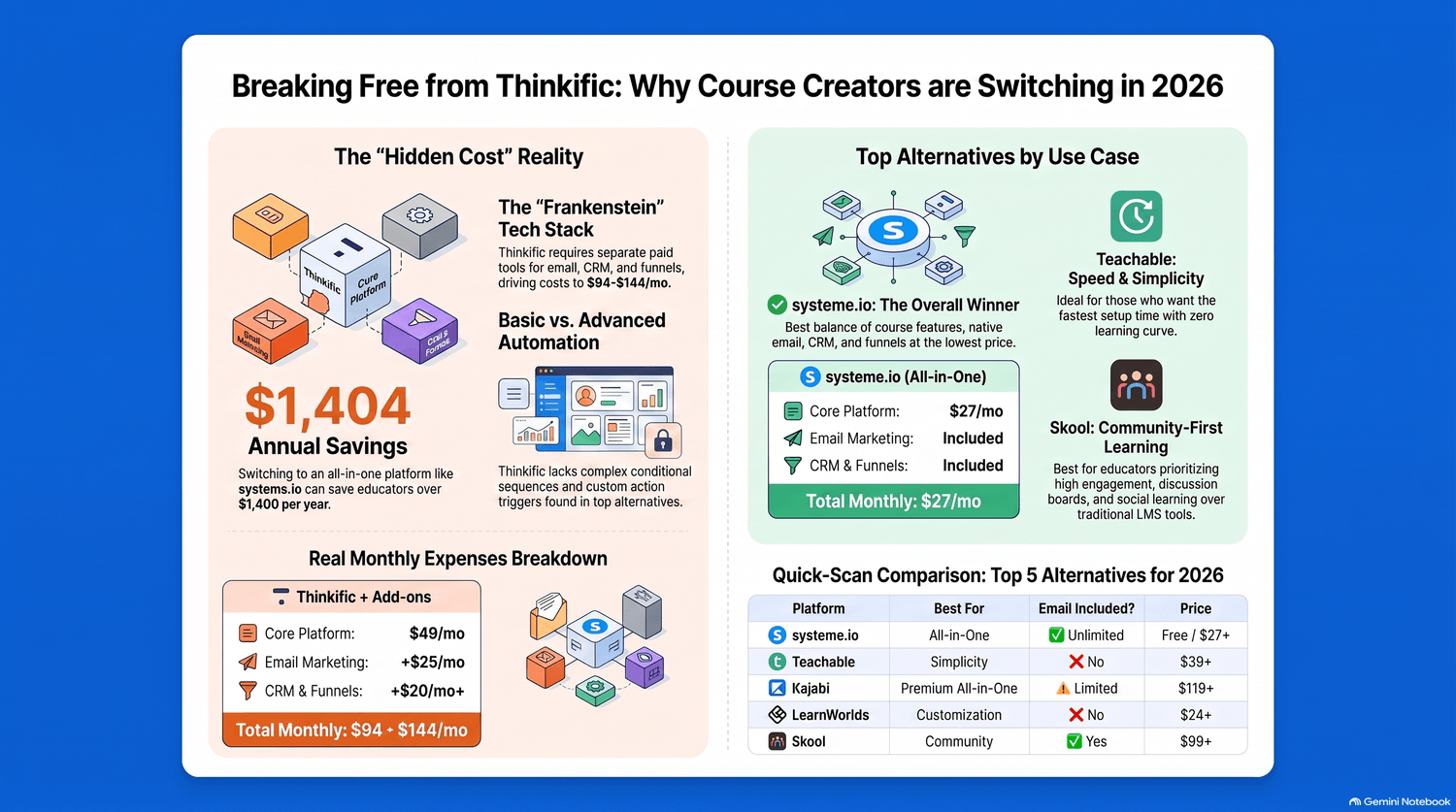
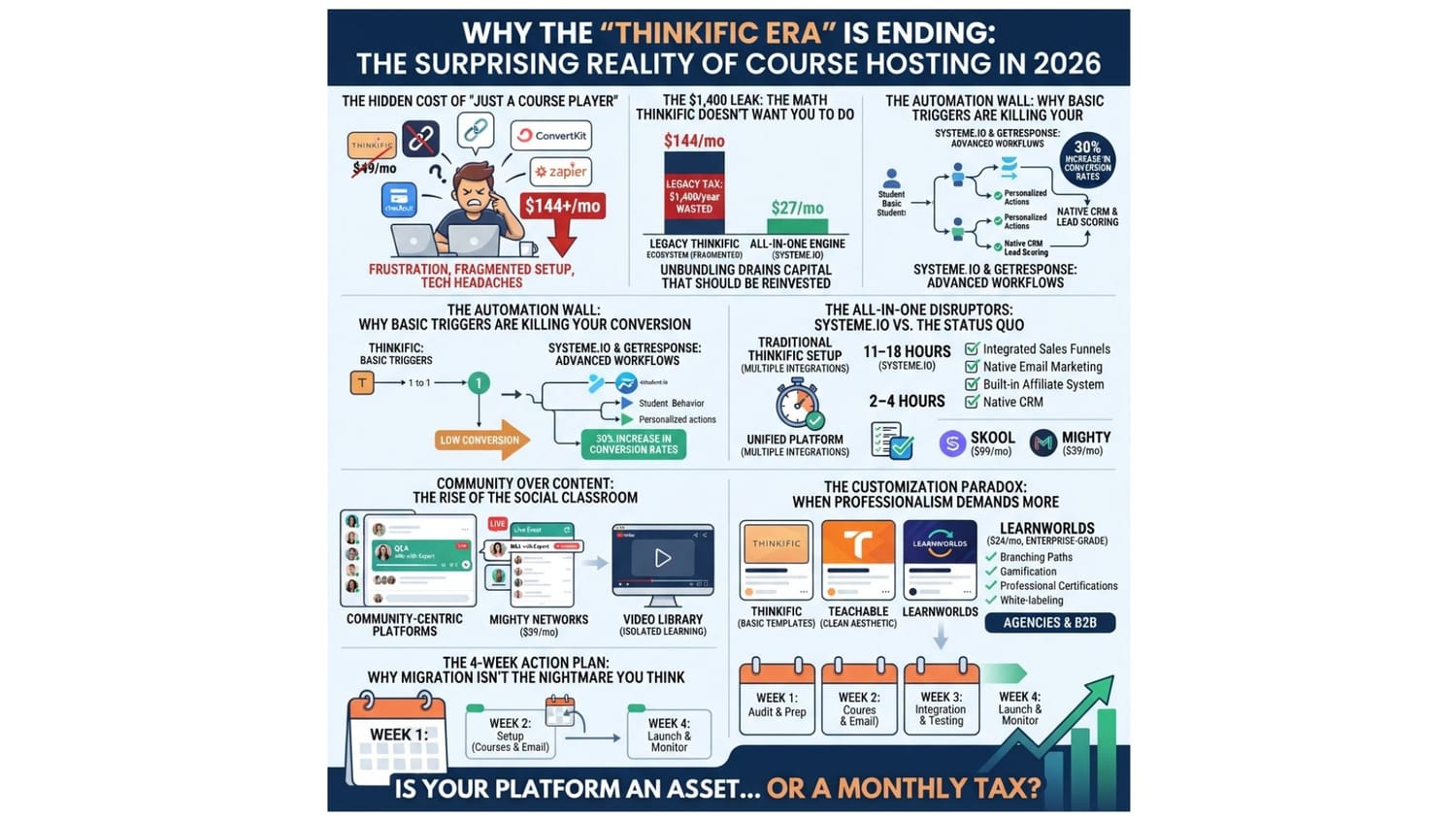
For years, the standard path for educators was simple: host your videos on Thinkific and "stitch" the rest of your business together using third-party plugins. However, in 2026, creators are hitting a wall of frustration, realizing they spend more time managing a fragile ecosystem than actually teaching. The initial appeal of Thinkific’s $49/mo entry price quickly dissolves into "sticker shock" once you realize that to run a functional business, you must pay for a separate email provider, a funnel builder, and a checkout tool.
The $1,400 Leak: The Math Thinkific Doesn't Want You to Do
When you unbundle your business tools, you aren't just creating a technical headache; you are paying a "fragmentation tax." A typical fragmented setup consisting of Thinkific Basic, an email tool like ConvertKit, and Zapier integrations can cost upwards of $144/mo. In contrast, an all-in-one engine like systeme.io provides the same capability for just ****$ 27/mo ."Switched from Thinkific to systeme.io... Saved $47/mo immediately and have 10x more capability."By eliminating this surplus spend, growth-minded creators are saving as much as $1,404/year . From a strategic perspective, unbundling is a legacy mistake that drains capital that should be reinvested into student acquisition and content quality.
The Automation Wall: Why Basic Triggers are Killing Your Conversion
Thinkific’s automation is limited to basic triggers , which are insufficient for the modern competitive landscape. Platforms like systeme.io and GetResponse offer advanced workflows and conditional sequences that respond to student behavior in real-time. Without a native CRM or lead scoring , creators are essentially flying blind, unable to identify their most engaged prospects.The commercial impact of this data gap is significant. Analytical data shows that "real switchers" who moved to platforms with integrated lead scoring reported a 30% improvement in conversion rates . By identifying high-intent leads automatically, these creators can focus their energy on the students most likely to purchase high-ticket upsells.
The All-In-One Disruptors: systeme.io vs. The Status Quo
The migration away from legacy platforms is driven by a demand for "Time to Value." While a Thinkific setup involving multiple integrations can take between 11–18 hours to configure, a unified platform like systeme.io allows for a full setup in just 2–4 hours . This efficiency allows creators to launch faster and iterate with less technical friction.systeme.io vs. Thinkific: Key Advantages
Integrated Sales Funnels: Build lead magnets and checkout flows directly in the dashboard.
Native Email Marketing: Unlimited sends and automated sequences without external fees.
Built-in Affiliate System: Track and pay affiliates without needing a $99/mo "Plus" tier.
Native CRM: Use lead scoring to optimize sales and track student engagement.
Community Over Content: The Rise of the Social Classroom
Thinkific suffers from a "structural gap" regarding member engagement; it is a library, not a classroom. Modern students increasingly value "social learning" and peer-to-peer interaction over isolated video watching. This shift has fueled the rise of community-centric platforms like Skool ( $99/mo) and Mighty Networks (****$ 39/mo ).These platforms differentiate themselves by offering Live Events and Q&A sessions natively within the member area. By integrating activity feeds, leaderboards, and real-time interaction, they solve the engagement problem that plagues traditional, video-only course players.
The Customization Paradox: When Professionalism Demands More
For some creators, the simplicity of a standard player leads to a "template-lock" that can dilute brand authority. When a business scales to an enterprise or B2B level, white-labeling becomes a non-negotiable requirement. LearnWorlds , starting at $24/mo , is the preferred choice for agencies reselling course experiences under their own brand.LearnWorlds offers depth that Thinkific lacks, including branching paths , gamification, and professional certifications. While Teachable ( $39/mo ) remains a popular choice for those prioritizing a clean aesthetic and fast deployment, LearnWorlds provides the enterprise-grade customization required for high-stakes professional training.
The 4-Week Action Plan: Why Migration Isn't the Nightmare You Think
The fear of technical downtime keeps many educators trapped in expensive, outdated systems. However, a structured transition can be completed within a month without interrupting the student experience. Following a clear roadmap removes the anxiety of moving data and domains.
Week 1: Audit & Prep: Document your current settings and download all videos and assets.
Week 2: Setup: Recreate your course structure and configure your automated email marketing sequences.
Week 3: Integration & Testing: Set up payment processors and perform end-to-end testing of the student journey.
Week 4: Launch & Monitor: Update your domain DNS, notify your students, and monitor engagement in your new CRM .
Conclusion: Beyond the Dashboard
By 2026, the definition of a "course platform" has evolved. It is no longer sufficient to simply host videos; a platform must function as a comprehensive business engine that manages leads, automates sales, and nurtures a community under a single roof. Legacy systems that charge a premium for a fragmented experience are quickly becoming obsolete.Is your platform an asset that builds your business, or a monthly tax that keeps you from scaling?
Study Guide: Evaluating Modern Course Creation Platforms and Alternatives
This study guide provides a comprehensive overview of the 2026 digital education platform landscape, specifically focusing on alternatives to Thinkific. It explores the shift from "course-only" tools to integrated business ecosystems that combine marketing, automation, and community features.
Section 1: Comprehension Quiz
Instructions: Answer the following questions based on the provided source context. Each response should be between two and three sentences.
What is the primary "hidden cost" associated with using Thinkific for a course business?
Why is systeme.io ranked as the "Best Overall" alternative to Thinkific?
What specific educational features make LearnWorlds suitable for agencies and institutions rather than individual creators?
How does Podia’s pricing structure compare to Thinkific regarding email marketing?
What is the fundamental difference between the "email-first" model of GetResponse and Thinkific’s model?
In the context of student engagement, what functionality does Skool provide that Thinkific lacks?
What are the primary strengths and weaknesses of using Teachable for a new educator?
Why is Kajabi considered a "premium" choice, and what are the associated tradeoffs for this status?
Explain the purpose of "Lead Scoring" within a platform's integrated CRM.
According to the 4-week migration plan, what should an educator prioritize during "Week 1: Preparation"?
Section 2: Answer Key
What is the primary "hidden cost" associated with using Thinkific for a course business? Thinkific's base price of $49/mo covers course hosting but does not include essential tools like email marketing or advanced automation. To run a complete business, users often must spend an additional $20–$ 40/mo for services like ConvertKit or Mailchimp, bringing the real cost closer to $69–$ 89/mo.
Why is systeme.io ranked as the "Best Overall" alternative to Thinkific? It provides a comprehensive business infrastructure by natively including email marketing, advanced automation, and CRM features that Thinkific requires as external add-ons. Furthermore, it offers a more transparent and affordable pricing model, including a functional free tier and a $27/mo startup plan.
What specific educational features make LearnWorlds suitable for agencies and institutions rather than individual creators? LearnWorlds offers high-level customization and "white-label" options that allow organizations to rebrand the platform entirely as their own. It also includes enterprise-grade features like branching learning paths, gamification, and professional certifications that exceed the capabilities of standard creator platforms.
How does Podia’s pricing structure compare to Thinkific regarding email marketing? Podia includes native email marketing with unlimited sends in its $33/mo entry price, whereas Thinkific users must pay $49/mo plus the cost of a third-party email provider. This integrated approach allows Podia to undercut Thinkific’s total monthly cost by a dramatic margin while offering similar course delivery.
What is the fundamental difference between the "email-first" model of GetResponse and Thinkific’s model? Thinkific is a course delivery platform that treats email as an afterthought or an external integration, often leading to lower deliverability. GetResponse reverses this by using a world-class email infrastructure as its core, with course hosting acting as a secondary delivery mechanism for established audiences.
In the context of student engagement, what functionality does Skool provide that Thinkific lacks? Skool is built as a community-driven environment featuring discussion boards, member activity feeds, and social interaction tools. Thinkific focuses almost exclusively on isolated content delivery and lacks these native social and interactive learning spaces.
What are the primary strengths and weaknesses of using Teachable for a new educator? Teachable's main strength is its extreme simplicity and professional design, allowing users to launch a course in hours without technical expertise. However, it lacks native email marketing, automation workflows, and CRM capabilities, which may necessitate the purchase of additional tools as the business grows.
Why is Kajabi considered a "premium" choice, and what are the associated tradeoffs for this status? Kajabi is a high-end, truly all-in-one platform that hosts everything from webinars to affiliate programs in a single dashboard. The tradeoffs include a significantly higher starting price of $119/mo and a steeper learning curve that may require over ten hours for initial configuration.
Explain the purpose of "Lead Scoring" within a platform's integrated CRM. Lead scoring allows educators to track student behaviors, such as who is opening emails, clicking links, or completing specific lessons. This data helps identify which students are the most engaged and most likely to purchase future courses or require personalized follow-up.
According to the 4-week migration plan, what should an educator prioritize during "Week 1: Preparation"? During the first week, an educator should perform a full audit of their current Thinkific account, documenting all content, drip settings, and analytics. They must also download all original assets, such as videos and PDFs, and select the specific alternative platform that best fits their needs.
Section 3: Essay Topics for Further Study
The Evolution of All-in-One vs. Modular Business Tools: Analyze the shift from using specialized tools like Thinkific to integrated platforms like systeme.io. Discuss the economic and operational impacts on a scaling education business.
The Role of Community in Modern Online Education: Compare "content-first" platforms with "community-first" platforms like Skool or Mighty Networks. Evaluate which approach is more effective for student retention and long-term business growth.
Strategic Platform Migration: Discuss the technical and psychological challenges of migrating a student body from one platform to another. Outline a strategy to minimize disruption and maintain student trust during a transition.
Customization and Branding in Course Design: Evaluate the importance of white-labeling and design flexibility, using LearnWorlds as a primary example. How does visual consistency affect conversion rates and brand authority for agencies?
Cost-Benefit Analysis of Enterprise Platforms: Compare the ROI of a $119/mo Kajabi subscription versus a $27/mo systeme.io plan. At what point does a creator's revenue justify the higher costs and steeper learning curves of premium tools?
Section 4: Glossary of Key Terms
Term,Definition
Affiliate System,A built-in tool that allows course creators to track and pay students or partners for referring new customers to their courses.
Automation Triggers,"Predefined actions (like course enrollment or quiz completion) that automatically start a sequence of events, such as sending a welcome email."
Branching Paths,Advanced course logic where a student's progress or the content they see changes based on their performance or choices.
CRM (Customer Relationship Management),"A system used to track student data, engagement history, and communication to manage the student lifecycle."
DNS Propagation,The 24–48 hour period it takes for domain name updates to be recognized across the entire internet after switching platforms.
Drip Scheduling,"A content delivery method where lessons are released to students over time (e.g., one lesson per week) rather than all at once."
Gamification,"The use of game-like elements such as points, badges, and leaderboards to increase student engagement and completion rates."
Lead Scoring,"A CRM feature that assigns numerical values to students based on their actions, identifying the most engaged or ""warm"" leads."
Sales Funnel,A step-by-step marketing process that guides a lead from an initial contact (like a lead magnet) to a final purchase and upsell.
White-Label,"A platform feature that allows a business to remove the provider's branding and replace it with their own, making the software appear custom-built."
Get Premium eCourses Package for FREE: https://www.nubeginning.com/plr-package
Free Funnel Certification: https://tinyurl.com/Funnel-Certification
Free All-in-one Platform trial: http://tinyurl.com/Systeme4u
Leave a reply
Copyright © 2022 SuePats.com - nuBeginning.com | All Rights Reserved | PRIVACY POLICY - TERMS & CONDITIONS - DISCLAIMER