
Top 10 Skool Alternatives for 2026 Comparison Guide
Top 10 Skool Alternatives for 2026 Comparison Guide
Get Premium eCourses Package for FREE: https://www.nubeginning.com/plr-package
Free Funnel Certification: https://tinyurl.com/Funnel-Certification
Free All-in-one Platform trial: http://tinyurl.com/Systeme4u
Top 10 Skool Alternatives for 2026 Comparison Guide
This text evaluates several software platforms that serve as alternatives to Skool for online business owners in 2026. It highlights how many creators are moving away from Skool due to its rising costs and a lack of integrated marketing tools like sales funnels and email automation. The guide identifies Systeme.io as the top overall choice for its comprehensive all-in-one features and affordability. Other specialized options are mentioned, such as Mighty Networks for high community engagement and Kajabi for premium branding. Ultimately, the source provides a detailed comparison of pricing and functionality to help users consolidate their digital toolkits.
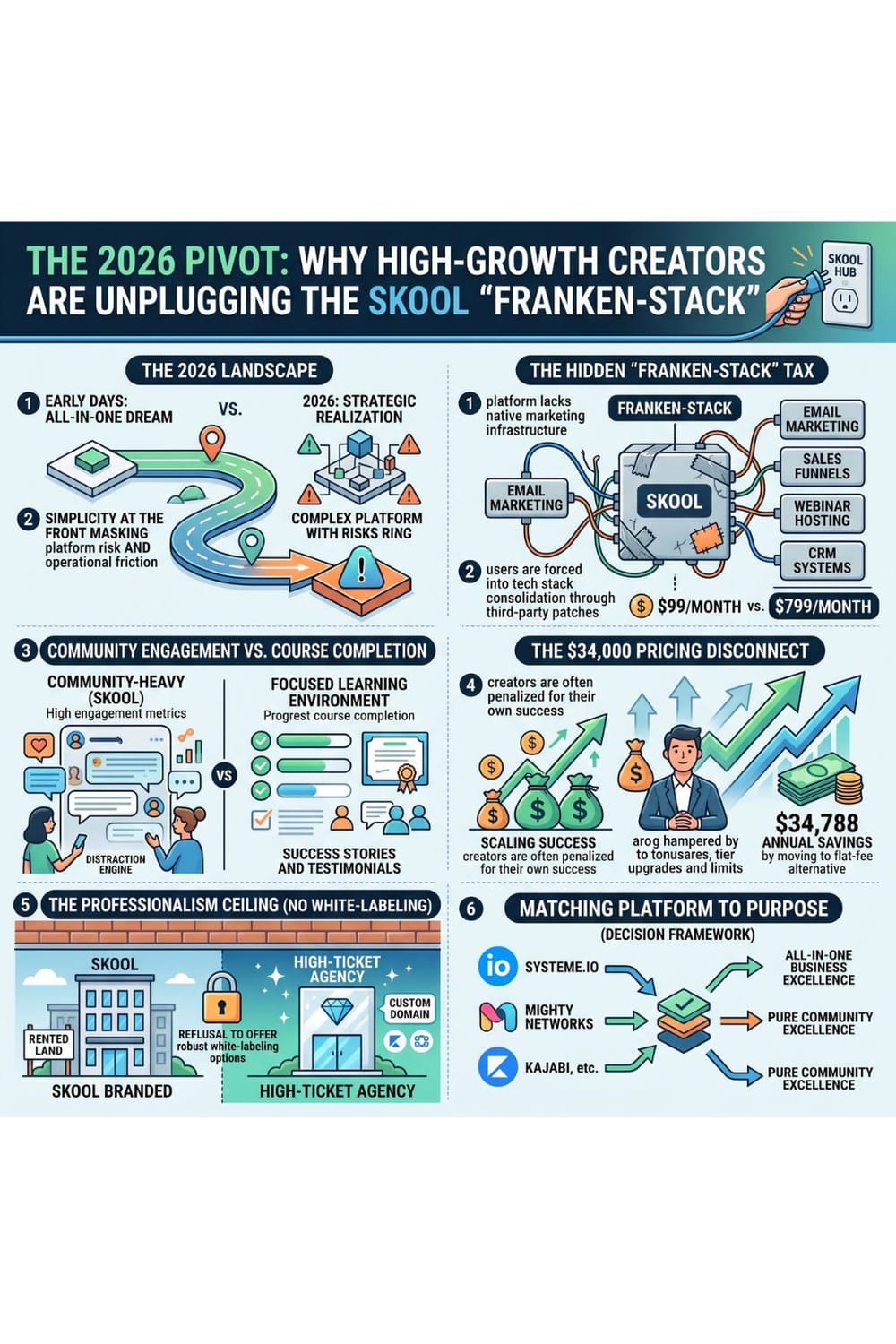
The 2026 Pivot: Why High-Growth Creators Are Unplugging the Skool "Franken-Stack"
1. The Hook: Why the "All-in-One" Dream is Changing
In the early days of the creator economy, the promise of an "all-in-one" platform was the ultimate siren song for entrepreneurs tired of duct-taping software together. Skool arrived with a revolutionary pitch: a beautifully designed space to house community and courses under one roof. For a season, it was the gold standard for CAC (Customer Acquisition Cost) efficiency and simple onboarding.However, as we navigate the 2026 landscape, the gap between what Skool promises and what a scaling business actually requires has widened into a chasm. "Tool fatigue" has evolved into a strategic realization: simplicity at the front end often masks massive platform risk and operational friction at the back end. For the sophisticated entrepreneur, the limitations of the "community-first" model are no longer just inconveniences—they are active barriers to growth.
2. Takeaway 1: The Hidden "Franken-Stack" Tax
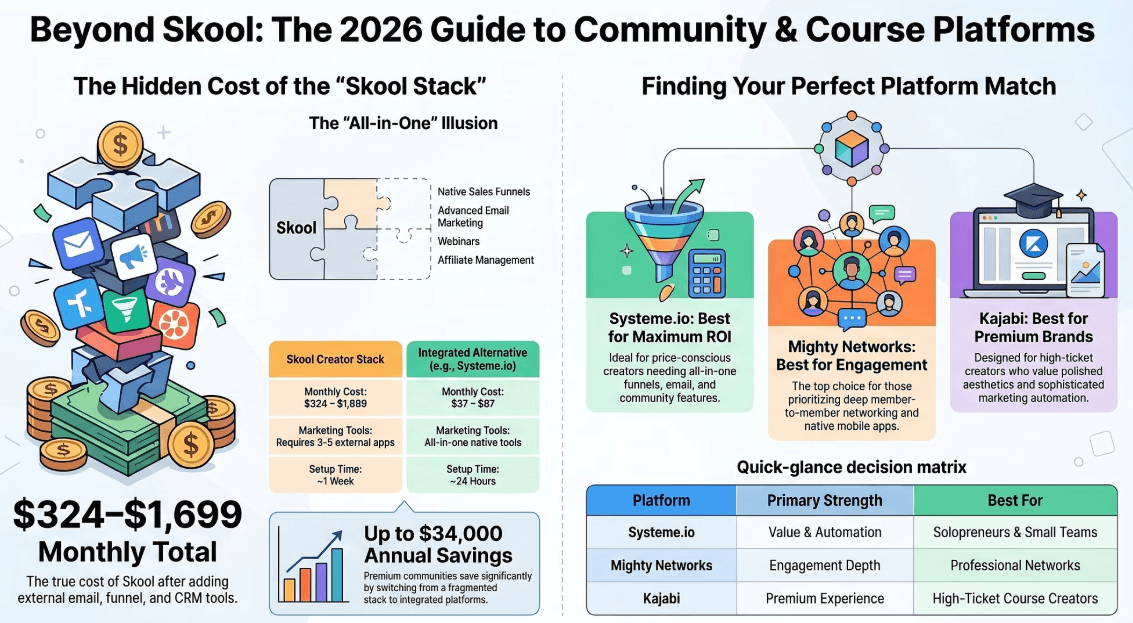
While Skool’s $99/month entry point appears accessible on a balance sheet, it is a deceptive figure for any creator past the "hobbyist" stage. Because the platform lacks native marketing infrastructure, users are forced into tech stack consolidation through third-party patches. This creates the irony of the "Franken-stack": an all-in-one platform that requires four additional subscriptions just to facilitate a basic sales cycle.To maintain professional operations, Skool users typically pay for:
Email Marketing: ConvertKit or ActiveCampaign for behavioral automation.
Sales Funnels: ClickFunnels or Leadpages for lead capture and upsells.
Webinar Hosting: Zoom or EverWebinar for live and automated conversion events.
CRM Systems: HubSpot or Salesforce to track member LTV and engagement history.Furthermore, while integrated competitors like Systeme.io allow for a 24-hour launch time , Skool's fragmented nature often results in a one-week setup period as you sync disparate APIs."We were using Skool for $199/month + ConvertKit for $300/month + Zoom for $200/month + Leadpages for $100/month. That's $799/month just for the basic stack. Switched to Systeme.io for $197/month and got everything — better email, funnels, webinars, the whole thing. We're saving $602/month and our community is more engaged." — Jennifer K., Community Creator
3. Takeaway 2: Community Engagement vs. Course Completion
Skool undeniably edges out competitors on community depth and its high-velocity native mobile app. However, from an analyst’s perspective, this "gold-plated" engagement is a double-edged sword. In 2026, the market is shifting toward focused learning environments because community-heavy platforms have become "distraction engines."When members spend more time scrolling discussion threads than completing the curriculum, it leads to LTV (Lifetime Value) erosion . High engagement metrics might look good on a dashboard, but without course completion, you lose the success stories and testimonials that form your brand's primary moat. For creators whose core promise is transformation, a social-first platform can actually become a subtle threat to their educational outcomes.
4. Takeaway 3: The $34,000 Pricing Disconnect
The most significant friction point for scaling businesses is the lack of favorable unit economics in Skool’s pricing model. With plans ranging up to $399/month and restrictive per-member limits, creators are often penalized for their own success, facing expensive tier upgrades exactly when they hit their growth stride.For premium community stacks (those generating $100K/month in revenue), the data is startling. By moving to a flat-fee, integrated alternative, a high-level creator can save upwards of $ 34,788 annually. In an era where profit margins are under pressure, reallocating thirty-four thousand dollars from software overhead into paid traffic or talent acquisition is the difference between a stagnant business and a market leader.
5. Takeaway 4: The Professionalism Ceiling (No White-Labeling)
In a saturated market, brand equity is your only true moat. Skool’s refusal to offer robust white-labeling options creates a "professionalism ceiling" for agencies and high-ticket brands. Being permanently tethered to Skool’s branding signals to your high-ticket clients that they are on "rented land."While enterprise-grade options like Mighty Networks Pro offer fully branded native apps for $999/month, here is an insider strategist tip: For most mid-market creators, the combination of Systeme.io for infrastructure and standard Mighty Networks for community provides a more robust, professional experience at a fraction of the enterprise cost. Custom domains and a bespoke UI are no longer "nice-to-haves"—they are non-negotiable for anyone charging premium prices.
6. Takeaway 5: Matching Platform to Purpose (The Decision Framework)
The 2026 landscape demands that you choose a platform based on your specific business model, not the current hype cycle.
For All-in-One Business Excellence: If you want to eliminate the "Franken-stack" and manage funnels, email, and CRM in one place, Systeme.io is the efficiency leader.
For Pure Community Excellence: If member-to-member networking and gamification are your only metrics for success, Mighty Networks remains the industry standard.
For Premium Course Creators: If you sell products at $500+ and prioritize high-end design aesthetics, Kajabi justifies its price tag through polished positioning.
For Professional Certification: For programs requiring advanced quizzes and compliance tracking, Thinkific or LearnWorlds are superior.
Analyst Warning: Be wary of Teachable ; their 25–30% transaction fees on lower tiers represent a massive hidden cost that can decimate your margins at scale.
For Membership-First Revenue: If your model is built on recurring tiers and subscription management, Circle offers the most seamless membership experience.
For Extreme Simplicity: If you are a solo creator testing a concept with zero need for community, Podia is the "30-minute launch" champion.
7. The Bottom Line: Moving Beyond the Hype
Skool was a revolutionary force that proved community and courses belong in the same ecosystem. However, as the digital market matures, smart entrepreneurs are realizing that a "conversation hub" is not a substitute for "business infrastructure."The 2026 landscape demands a move toward integrated sales funnels, sophisticated automation, and radical financial efficiency. The question every creator must eventually ask is simple: Is your current platform a unified engine driving your growth, or is it just a place where people go to talk?
Study Guide: Community and Course Platform Alternatives 2026
This study guide provides a comprehensive analysis of the evolving landscape of online community and course platforms. It examines the limitations of previous market leaders and synthesizes the features, pricing, and strategic advantages of contemporary alternatives available in 2026.
The Evolution of the Platform Market
By 2026, the digital creator economy has shifted away from fragmented tool stacks toward integrated ecosystems. While platforms like Skool initially revolutionized the space by combining community and courses, creators are increasingly identifying "breaking points" that necessitate a transition to more robust alternatives.
The Limitations of the Legacy Model
The move away from Skool is driven by four primary factors:
Tool Fragmentation: Users often require 3–5 external tools (e.g., ConvertKit, ClickFunnels, Zoom) to compensate for missing native features.
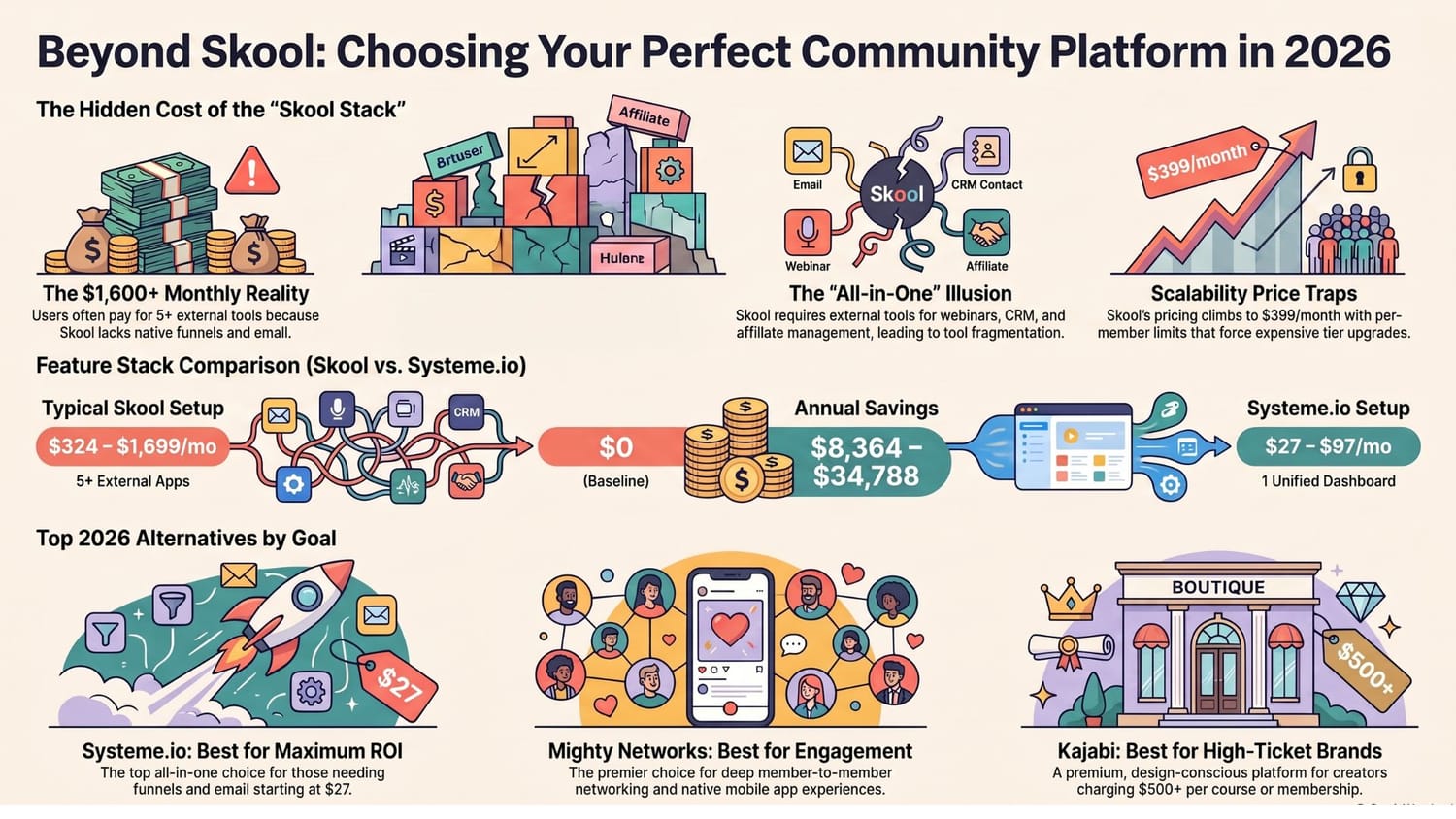
Cost Escalation: Base prices ranging from $99 to $399/month, combined with the cost of external subscriptions, can lead to monthly overhead between $324 and $1,699.
Lack of Marketing Infrastructure: A notable absence of native sales funnels and advanced email marketing prevents creators from building pre-community engagement.
Limited Customization: The inability to white-label platforms or utilize advanced CRM features restricts professional positioning for agencies and high-ticket coaches.
Comprehensive Platform Analysis
The following platforms represent the primary alternatives for creators, categorized by their core strengths and target demographics.
1. All-in-One Solutions
Systeme.io is identified as the "Best Overall" alternative due to its unified dashboard.
Core Advantage: Integrates community, courses, email marketing, sales funnels, webinars, CRM, and affiliate management.
Pricing Structure: Features a flat-rate model ( $27–$ 297/month) with unlimited members and no per-member fees.
Strategic Value: Eliminates the "Creator Stack" cost, offering potential annual savings of $8,364 to $34,788 for growing communities.Kajabi serves the premium segment.
Best For: High-earning creators charging $500+ per course.
Focus: Polished design, advanced funnel builders, and white-glove support.
Pricing: $119–$ 319/month.
2. Community-First Platforms
Mighty Networks and Circle prioritize member-to-member interaction over course delivery.
Mighty Networks: Offers industry-leading engagement tools (gamification, badges, live sessions) and a superior native mobile app. It scales to an Enterprise "Pro" tier ($999+/month) for white-labeled mobile apps.
Circle: Optimized for membership-based recurring revenue, featuring clean automated tier management and billing.
3. Course-First and Enterprise Platforms
Thinkific: Best for professional certifications and organizations requiring prerequisites, assignments, and grading logic.
LearnWorlds: The enterprise choice, offering SCORM/xAPI compliance and full white-labeling for corporate training.
Teachable: A beginner-friendly option for fast launches, though it carries high transaction fees (25–30%) on lower tiers.
Platform Feature Comparison Matrix
Feature,Skool,Systeme.io,Mighty Networks,Kajabi,Circle
Price (Min),$99/mo,$27/mo,$39/mo,$119/mo,$39/mo
Sales Funnels,No,Yes (Native),No,Yes (Native),No
Email Marketing,Basic,Excellent,3rd-Party,Excellent,3rd-Party
CRM,No,Yes (Full),No,Yes,No
Affiliate Tool,No,Yes,No,Yes,No
Mobile App,Native,Mobile Web,Native,Native,Native
Economic Impact: The "Creator Stack" vs. Integrated Platforms
A significant portion of the source material focuses on the "Real Cost" of platform maintenance. The "Skool Creator Stack" typically includes:
Base Platform: $99–$ 399
Email (ConvertKit): $25–$ 500
Webinar (Zoom): $15–$ 200
Funnels (ClickFunnels): $97–$ 297
CRM (HubSpot): Up to $500The Result: Switching to an integrated platform like Systeme.io (at $97/month for a Business plan) can save premium communities nearly $35,000 annually by consolidating these services.
Quiz
Instructions: Answer the following questions in 2–3 sentences based on the source context.
What are the specific "Breaking Points" that cause community builders to reassess the Skool platform in 2026?
How does the pricing model of Systeme.io differ from Skool regarding member limits and feature tiers?
Why is Mighty Networks considered the best choice for "Pure Community Engagement"?
What is the primary financial risk associated with using Teachable’s lower-tier plans?
Explain the concept of "Tool Fragmentation" as described in the source.
For whom is Thinkific specifically designed, and what features support this target audience?
What distinguishes LearnWorlds as an "Enterprise" platform compared to more simplified options?
Describe the primary focus of the Circle platform and who would benefit most from it.
Why does the source suggest that a high-engagement community can sometimes become a "Distraction Engine"?
What is required to migrate a community from Skool to another platform, and how long does the process typically take?
Quiz Answer Key
Breaking Points: Creators are leaving due to the lack of native sales funnels, basic email marketing capabilities, and rising costs that reach up to $399/month. Additionally, the need to juggle 3–5 external tools defeats the promise of an all-in-one experience.
Pricing Model: Unlike Skool, which has per-member limits that force expensive upgrades, every Systeme.io plan includes unlimited communities, courses, members, and emails. Systeme.io offers a much lower entry point at $27/month compared to Skool’s $99/month minimum.
Mighty Networks: It offers the most sophisticated engagement tools available, including direct messaging, gamification, badges, and leaderboards. Its native iOS and Android apps with push notifications provide a superior mobile experience for member-to-member networking.
Teachable Risk: Teachable charges 25–30% transaction fees on course sales at lower tiers, which significantly erodes profit margins as a business scales. Most creators eventually find they outgrow the Basic plan because of these high costs.
Tool Fragmentation: This occurs when a platform lacks essential business features, forcing the user to pay for and manage multiple external subscriptions like ConvertKit for email or ClickFunnels for sales. This increases both the monthly financial overhead and the technical complexity of running the business.
Thinkific: It is built for professional educators, organizations, and certification programs that prioritize a course-first functionality. It includes advanced features such as prerequisites, branching logic, assignments with grading, and detailed completion analytics.
LearnWorlds Enterprise: It provides SCORM/xAPI compliance, learning record stores, and full white-labeling with custom mobile apps, making it suitable for corporate training. It also features enterprise-level security and GDPR compliance that solo-creator platforms often lack.
Circle: Circle is a membership-first platform designed for creators seeking sustainable recurring revenue through tiered access. It excels at managing member levels and automated billing within a modern, mobile-responsive interface.
Distraction Engine: The source notes that notification-heavy communities and mobile apps can hurt course completion rates. Members may spend more time chatting and scrolling through discussions rather than focusing on the educational content they purchased.
Migration: Migration is a manual process involving the export of member lists via CSV, exporting course content, and reconfiguring automations on the new platform. This process typically takes between 12 and 40 hours depending on the size of the community and the volume of content.
Essay Questions
Instructions: Use the information from the source to develop comprehensive responses to the following prompts. (Answers not provided).
The All-in-One Debate: Analyze the strategic advantages and disadvantages of using a single unified platform (like Systeme.io) versus a "best-of-breed" stack (like Skool plus specialized third-party tools).
Economic Scalability: Evaluate how different pricing structures—specifically transaction fees, per-member limits, and flat-rate subscriptions—impact the long-term profitability of a growing online community.
Educational vs. Social Priorities: Discuss the tension between community engagement and course completion, examining how different platforms (e.g., Thinkific vs. Mighty Networks) prioritize one over the other.
The Enterprise Shift: Explain the specific requirements of corporate and large-scale organizations (such as SCORM compliance and white-labeling) and identify which platforms in the 2026 market are best positioned to meet these needs.
Market Maturity: Using the "Breaking Points" mentioned in the text, describe how the expectations of course creators have evolved from the "revolutionary" launch of Skool to the more demanding requirements of 2026.
Glossary of Key Terms
Affiliate Program: A built-in system allowing creators to track commissions and manage partners who promote their products for a percentage of sales.
All-in-One Platform: A unified dashboard that combines multiple business functions—such as email, funnels, CRM, and courses—into one subscription.
CRM (Customer Relationship Management): A database tool used to track member engagement, lifetime value, and communication history.
Drip-feed: A content delivery method where course materials are released to students gradually over time rather than all at once.
Gamification: The use of elements like badges, leaderboards, and points to encourage active participation within a community.
Sales Funnel: A series of marketing steps, including landing pages and one-click upsells, designed to guide a lead toward a purchase.
SCORM/xAPI: Technical standards for e-learning software that ensure course content is compatible with enterprise-level learning management systems.
Tool Fragmentation: The inefficient state of using multiple, disconnected software applications to perform basic business operations.
Transaction Fee: A percentage of a sale taken by the platform provider, common in the lower pricing tiers of services like Teachable.
White-Labeling: The ability to remove the platform's branding and replace it with the creator’s own, often including custom domains and branded mobile apps.
Get Premium eCourses Package for FREE: https://www.nubeginning.com/plr-package
Free Funnel Certification: https://tinyurl.com/Funnel-Certification
Free All-in-one Platform trial: http://tinyurl.com/Systeme4u
Leave a reply
Copyright © 2022 SuePats.com - nuBeginning.com | All Rights Reserved | PRIVACY POLICY - TERMS & CONDITIONS - DISCLAIMER