
The Death of the Professional Email
The Death of the Professional Email: Why Your Best Marketing Isn’t Marketing At All
The Death of the Professional Email: Why Your Best Marketing Isn’t Marketing At All
Human Connections in the Digital Inbox
Modern digital communication often fails because it relies on stale corporate jargon and generic formatting that triggers a delete reflex in the reader. To overcome low engagement rates, authors must prioritize human connection by utilizing the first fifty characters of a message to bypass both human boredom and AI summarizers. The text emphasizes shifting from broad categories to vivid, sensory-rich moments that anchor a reader's attention through vulnerability and specificity. Writers are encouraged to adopt a "signature move" to ensure their voice remains distinct and recognizable even without a sender name. Effective marketing avoids aggressive selling, instead using an empathy bridge to validate the reader's struggles before offering a solution. Ultimately, success in the inbox requires front-loading value and focusing on the word "you" to transform a broadcast into a personal conversation.
1. Introduction: The 80% Invisible Audience
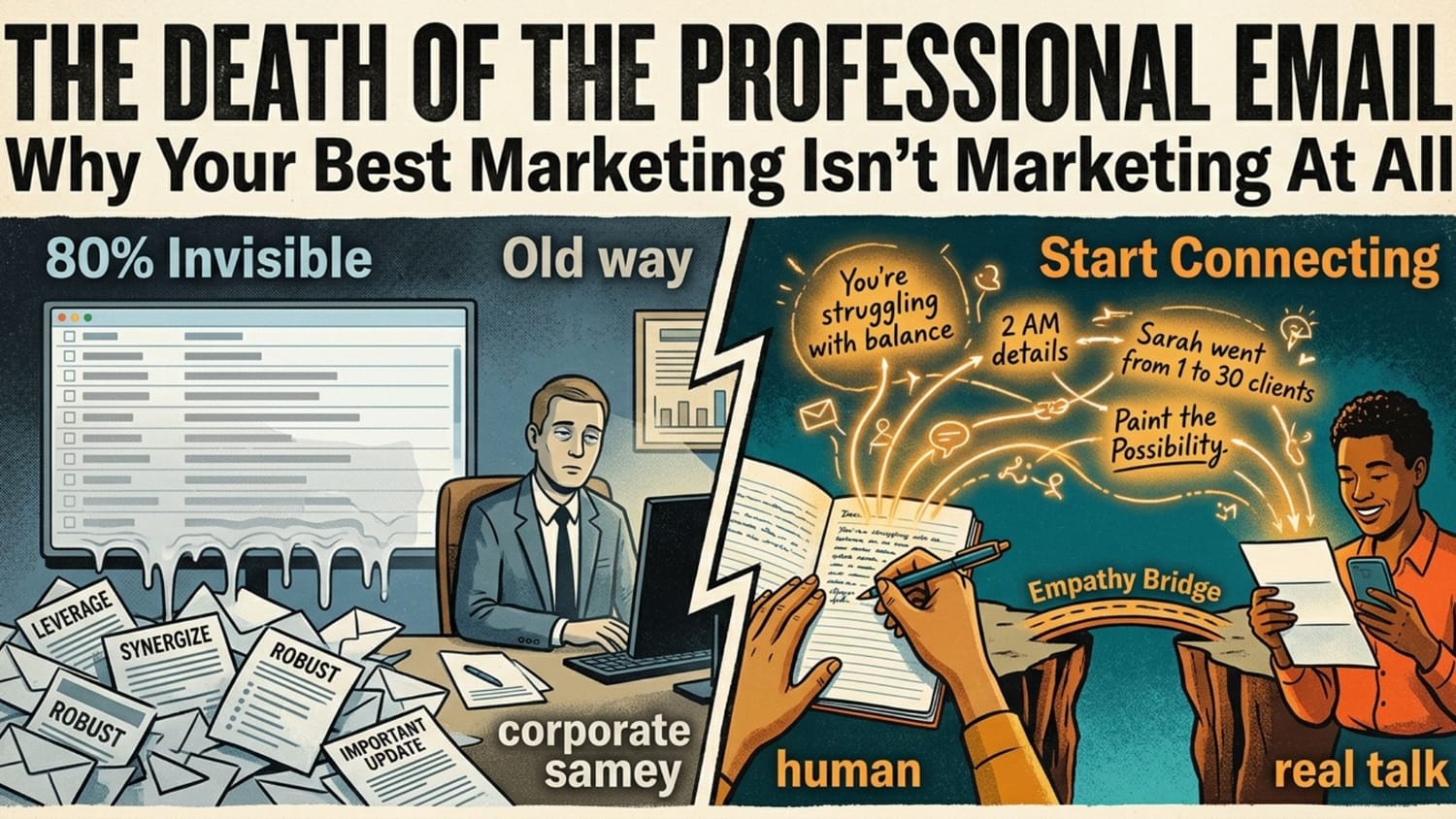
The brutal truth of digital communication? Most of your messages are dead before they’re even opened.Industry data is staggering: the average marketing email sees a meager 15–20% open rate and a 2–3% click rate. Do the math. That means 80% of your audience is invisible. They never see your message. Nearly 98% never take action.Most writers fail because they are "samey." They are boring. They blend into the inbox with corporate-sounding memos that trigger a delete reflex before the first sentence is finished. The difference between a forgettable email and one that commands attention isn't your budget or your software. It’s a return to writing fundamentals. It’s about human connection.If you want to win, you have to stop "marketing" and start connecting.
2. The 50-Character Battlefield
One second. That is your window.On mobile devices, your reader sees three things: your name, the first 40–50 characters of your subject line, and a tiny preview snippet. This is the only real shot you have at earning a click. If you waste this space on slow setups or corporate filler, you’re gone.But there’s a new gatekeeper in town: AI-driven mailbox summarizers. Google, Apple, and Microsoft now summarize your emails for the user. If your core message isn't front-loaded, it's essentially invisible to the AI.The data is clear:
87.1% of Google keyword matches come from the first half of the email.
82.5% for Apple.
65.4% for Microsoft.If your offer lives in a graphic or at the bottom of the page, the summary has nothing to say about it. Front-load your most intriguing words. Use the "Curiosity Gap"—say enough to intrigue, but not enough to satisfy.The Subject Line Test| Weak First 50 Characters | Strong First 50 Characters || ------ | ------ || "Important information about your account that you..." | "Stop wasting time in your inbox (here's proof)" || "We're excited to announce the launch of our new..." | "You've been doing this wrong (and here's the fix)" |
3. The Power of "You" (and the End of Jargon)
"You" is the single most powerful word in your arsenal.It transforms a generic broadcast into a personal connection. Contrast the distance of "Many entrepreneurs struggle with balance" with the directness of "You're struggling with balance." The first is a statistic; the second is a mirror. It shows you understand their specific situation without them saying a word.To keep that connection, you must kill the "Jargon Filter." Corporate speak creates distance. Real talk creates trust. Wishy-washy writing gets skipped.The Jargon Filter| Corporate Word | "Real Talk" Equivalent || ------ | ------ || Leverage / Utilize | Use || Maximize | Get more of || Synergize | Work together || Facilitate | Help || Robust | Strong |
"The moment you start hedging everything with 'might,' 'could,' and 'possibly,' you've already lost them."
4. Moments, Not Categories: The Vulnerability Anchor
If you want your stories to stick, you have to write "moments," not "categories."A category is a vague state of being: "I was struggling with productivity." It’s safe. It’s also forgettable. A moment is a sensory-rich snapshot in time. It uses specificity—the "Anchor"—to lodge the story in the reader’s brain.
Category: "I was frustrated with my business."
Moment: "I was crying in my car before a client meeting because I was terrified I’d be exposed as a fraud."Use the 2 AM details. Use real dialogue. "I was answering emails at 2 AM. My wife asked, 'Why are you still working?' I didn't have an answer."That specificity—the time, the quote, the raw emotion—is the bridge between your experience and your reader’s inner world.
5. Developing Your "Signature Move"
Readers should know it’s you before they ever see the "From" field. This is your "Signature Move"—a unique element used so consistently that it becomes your identity.The Four Types of Signature Moves:
Catchphrases: Repeated phrases that become your "voice." Example: "That’s the whole thing."
Structures: Consistent formatting, like always using a three-part list or a specific P.S. style.
Tones: A specific "vibe," whether it's irreverent humor, nerdy deep-dives, or warm mentorship.
Personal Elements: Recurring features like a specific reply prompt or a personal anecdote.The Unforgettable Test: If you removed your name from the email, would a subscriber still know it was from you? If not, you’re too generic.
6. The Empathy Bridge: Selling Without Being "Gross"
Most emails fail by selling too fast. You cannot sell something people don't consciously want yet. Your job is to build desire by making them feel the problem again—not to cause pain, but to show it’s fixable.Before you pitch, you must go through three stages:
Paint the Possibility: Show them what life looks like when the problem is gone.
Show the Cost: What is staying the same actually costing them in time, money, or peace?
Show the Problem: Make the struggle vivid and real.Once the desire is built, use the Bridge to transition to the offer. The bridge has three parts:
Acknowledgment: Validating their feeling (e.g., "If you're feeling burnt out...").
Realization: Sharing a discovery ("I realized most people don't know how to change without losing what they've built").
Reason for the Pitch: Explaining that your product exists as the specific relief for that problem."The biggest mistake most email writers make is selling too fast... you can't sell something people don't consciously want yet. But you can create the desire to have it—before you ever mention what it is."
7. Credibility Without Bragging
You need authority, but nobody likes a "braggy blowhard." The secret is "Show, Don't Tell."Instead of saying "I'm a great coach," use Third-Party Validation . Instead of saying "I help businesses grow," use Specific Results .Example: "Sarah went from 1 to 30 clients in 6 months using this system."By focusing on the impact on the client rather than your own greatness, the proof serves the reader. It shows them what is possible for them .
8. Conclusion: Write One Email That Matters
These "secrets" aren't tricks. They are the fundamentals that most people are too lazy to follow. They require you to move from corporate distance to human intimacy.This week, I challenge you to write just one email that breaks the mold.
Use a subject line that passes the 50-character test.
Front-load your value for the AI summarizers.
Tell a specific story with a real, raw moment.
Use a "you-focused" approach that makes your reader feel seen.When you write as one human being to another, the engagement and revenue will follow.Now go write an email that matters.
Study Guide: Human-Centric Digital Communication and the Evolution of Email Marketing
This study guide provides a comprehensive overview of the strategies and psychological principles required to navigate the modern landscape of digital communication, as outlined in "The Death of the Professional Email: Why Your Best Marketing Isn’t Marketing At All."
Part 1: Short-Answer Quiz
Instructions: Answer the following questions in two to three sentences based on the provided text.
What is the "80% Invisible Audience," and what causes it?
How do mobile devices and AI-driven mailbox summarizers change the strategy for writing email subject lines?
Explain the significance of the "Curiosity Gap" in digital messaging.
Why is the word "You" considered the most powerful tool in a writer’s arsenal?
What is the "Jargon Filter," and why is it necessary for building trust?
Distinguish between a "Category" and a "Moment" in storytelling.
What is the purpose of a "Signature Move," and how is its effectiveness tested?
According to the text, why is "selling too fast" a mistake in email marketing?
Describe the three components of the "Bridge" used when transitioning to a sales pitch.
How should a writer establish credibility without appearing to brag?
Part 2: Answer Key
What is the "80% Invisible Audience," and what causes it? The invisible audience refers to the roughly 80% of recipients who never open marketing emails, based on industry data showing a meager 15–20% open rate. This lack of engagement is caused by "samey" or boring corporate-sounding memos that trigger a delete reflex before the recipient reads the first sentence.
How do mobile devices and AI-driven mailbox summarizers change the strategy for writing email subject lines? On mobile, readers only see the sender's name, the first 40–50 characters of the subject line, and a tiny preview, making it essential to front-load the most important information. Furthermore, AI summarizers from Google, Apple, and Microsoft prioritize the first half of the email, meaning messages not front-loaded become invisible to these tools.
Explain the significance of the "Curiosity Gap" in digital messaging. The Curiosity Gap is a technique used to earn a click by providing enough information to intrigue the reader without satisfying their curiosity immediately. By front-loading intriguing words and withholding the full resolution, writers can bypass the "delete reflex" and encourage further engagement.
Why is the word "You" considered the most powerful tool in a writer’s arsenal? The word "You" transforms a generic broadcast into a personal connection by acting as a mirror for the reader’s specific situation. It replaces distant statistics with direct address, signaling to the reader that the writer understands their unique struggles.
What is the "Jargon Filter," and why is it necessary for building trust? The Jargon Filter is the process of replacing "corporate speak" (like "leverage" or "synergize") with "real talk" equivalents (like "use" or "work together"). This is necessary because corporate jargon creates emotional distance, whereas simple, direct language builds trust and prevents the reader from skipping the content.
Distinguish between a "Category" and a "Moment" in storytelling. A category is a vague, forgettable state of being, such as "struggling with productivity," which feels safe but unengaging. A moment is a sensory-rich, specific snapshot in time, like "crying in the car at 2 AM," which uses "anchors" to lodge the story in the reader’s memory.
What is the purpose of a "Signature Move," and how is its effectiveness tested? A Signature Move is a unique element—such as a catchphrase, structure, tone, or personal element—used consistently to create a recognizable identity. Its effectiveness is measured by the "Unforgettable Test": if the sender's name were removed, would the subscriber still know who wrote the email?
According to the text, why is "selling too fast" a mistake in email marketing? Selling too fast fails because people cannot be sold something they do not yet consciously want. The writer’s job is to first build desire by making the reader feel the problem vividly and showing that it is fixable before introducing the product.
Describe the three components of the "Bridge" used when transitioning to a sales pitch. The bridge consists of Acknowledgment, Realization, and the Reason for the Pitch. It involves validating the reader’s feelings, sharing a discovery or insight, and then explaining how the specific product or service acts as the relief for the identified problem.
How should a writer establish credibility without appearing to brag? Writers should use "Third-Party Validation" and "Specific Results" rather than making self-congratulatory claims. By showing how a specific system helped a client achieve a measurable result, the proof serves the reader by demonstrating what is possible for them.
Part 3: Essay Questions
The Evolution of the Inbox Gatekeeper: Analyze how the rise of AI-driven mailbox summarizers and mobile-first consumption has fundamentally changed the "battlefield" of digital communication.
The Psychology of Specificity: Discuss the role of "Vulnerability Anchors" and "2 AM details" in bridging the gap between a writer’s experience and a reader’s inner world.
Human Connection vs. Corporate Marketing: Evaluate the argument that "marketing" is less effective than "connecting," and explain how "real talk" influences consumer trust.
Strategic Empathy in Sales: Explore the ethics and mechanics of the "Empathy Bridge," focusing on how painting the "cost of staying the same" can motivate a reader to take action.
The Architecture of a Signature Move: Develop a framework for how a brand can move from being "generic" to "unforgettable" using catchphrases, structures, and tones.
Part 4: Glossary of Key Terms
Term,Definition
80% Invisible Audience,The portion of a digital audience that never opens or interacts with messages due to low industry open and click rates.
The 50-Character Battlefield,The limited space available in mobile subject lines and preview snippets to capture a reader's attention within one second.
AI Mailbox Summarizers,"Tools used by Google, Apple, and Microsoft to condense email content for users; they prioritize information found in the first half of the message."
Curiosity Gap,"A writing technique that provides enough information to spark interest but not enough to satisfy it, prompting the reader to click."
Jargon Filter,"The practice of removing corporate-speak and hedging language (e.g., ""maximize,"" ""possibly"") in favor of direct, simple language."
Category,"A vague, generic description of a state of being or problem that lacks emotional resonance."
Moment,"A sensory-rich, specific snapshot in time used in storytelling to create a ""vulnerability anchor"" for the reader."
Signature Move,"A consistent, unique element (catchphrase, structure, or tone) that makes a writer's work identifiable even without their name."
The Unforgettable Test,"A diagnostic tool to determine if a writer's voice is distinct enough to be recognized by subscribers without a ""From"" field."
The Empathy Bridge,"A three-part transition (Acknowledgment, Realization, Reason for Pitch) used to connect a reader's problem to a specific offer."
Third-Party Validation,The use of client results or external proof to establish authority and credibility without self-promotion.
Front-loading,"The strategy of placing the most important words, offers, or intriguing content at the very beginning of an email to satisfy AI and human readers."
Leave a reply
Copyright © 2022 SuePats.com - nuBeginning.com | All Rights Reserved | PRIVACY POLICY - TERMS & CONDITIONS - DISCLAIMER