
Infinite Prosperity through The Bhagavad Gita
The Power of the Irresistible Offer
Summary Video
Deep Dive Audio
Get Premium eCourses Package for FREE: https://www.nubeginning.com/plr-package
Free Funnel Certification: https://tinyurl.com/Funnel-Certification
Free All-in-one Platform trial: http://tinyurl.com/Systeme4u
The Power of the Irresistible Offer
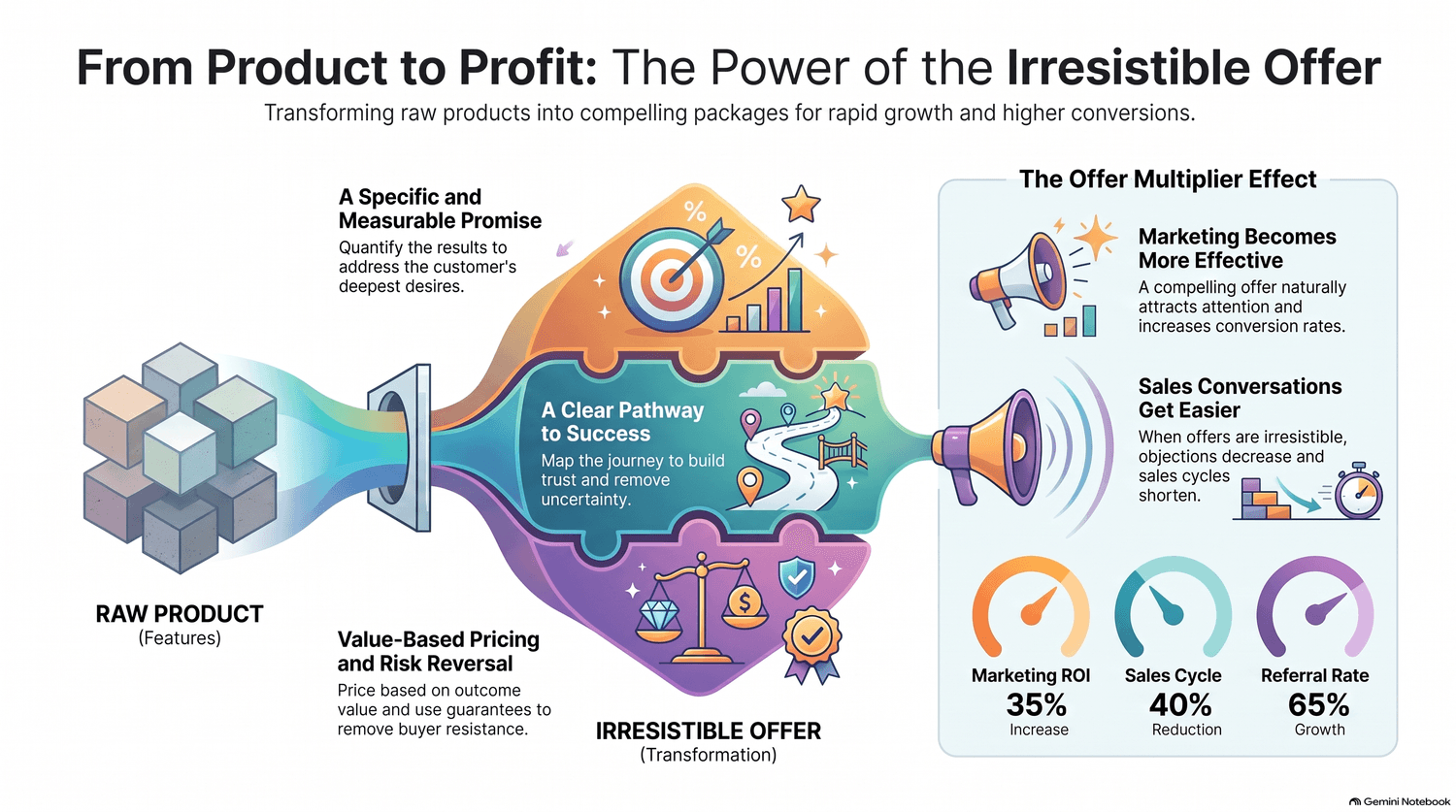
This source outlines how businesses can achieve rapid growth by prioritizing compelling offers over basic products or traditional marketing tactics. It defines an effective offer as a complete package that includes a measurable promise, a clear methodology, and strategic pricing that minimizes buyer risk. The text emphasizes that poor sales are often the result of vague messaging rather than product flaws, suggesting that entrepreneurs should simplify their services to highlight a specific transformation. Through various case studies and the example of Netflix’s business model, the guide illustrates how shifting from selling features to selling emotional outcomes can disrupt industries. Ultimately, the material serves as a framework for optimizing business gears like sales and retention by building a proprietary and irresistible value proposition.
The "Offer" Illusion: Why Great Products Fail and How Netflix-Style Thinking Can Save Your Business
The Hook: The Quiet Business Killer
You have a high-quality product, your marketing is consistent, and your team is firing on all cylinders. Yet, sales are stagnant. Most founders in this position retreat to the familiar: they buy more ads, pivot their niche, or demand more features from their dev team. They are rearranging furniture in a house nobody knows exists.The reality is that sales don't stall because of a lack of effort; they stall because of a weak offer. The "hidden growth lever" that transforms business trajectories isn't a better product—it is the shift from selling a solution to selling an irresistible package. If your market is responding with a shrug, you don't have a marketing problem. You have an "Offer Illusion."Stop focusing on technical specifications. Real growth is unlocked the moment you stop selling what you do and start selling the transformation the market is starving for.
Takeaway #1: Your Product is Not Your Offer
To scale, you must internalize a fundamental mindset shift: your product is not your offer. A "product" is the raw solution—the software code, the coaching hours, or the physical goods. It is focused on features and functionality. An "offer" is the complete package. It is the bridge between a customer’s current pain and their desired future.The evolution of Netflix is the ultimate case study in this distinction. In the traditional rental model, the "product" was a movie. However, the offer was toxic: it included per-movie fees, late penalties, and the hassle of physical inventory. Netflix didn't change the movie; they changed the offer. By introducing unlimited streaming for a flat monthly fee with zero late fees and instant access, they created a revolutionary package that disrupted an entire industry.Most business owners fail because they obsess over features, while customers only care about the experience and the end result.Offer Definition: The complete package—how you present, structure, and deliver your product to solve specific problems and provide a clear transformation.
Takeaway #2: Specificity is the Secret to Connection
Broad messaging is the death of conversion. When you try to speak to everyone, you resonate with no one. Strategic growth requires talking to a "precise individual" at a "particular stage" of their journey.Consider the "Agency Owner Coaching" case study. A coach was struggling to sign more than 1-2 clients a month because his messaging was directed at "freelancers and agencies." By narrowing the focus specifically to agency owners generating $5k–$ 20k monthly—those stuck at a very specific glass ceiling—sign-ups jumped to 4–5 per month within six weeks.The price, the product, and the deliverables never changed. Only the specificity did. This works because extreme narrowing makes the prospect feel like you are reading their mind. That psychological connection fosters a level of trust that broad marketing can never replicate.
Takeaway #3: Sell Feelings, Not Features
If you are selling "more leads," you are competing on price. If you are selling "financial security" and the relief of never starting from zero again, you are building a category of one. You must address the underlying emotional driver, not just the surface-level want.Use this "Cheat Sheet" to audit your current promises. If your promise looks like the left column, you are leaving millions on the table:The Promise Audit
Weak Promise: "Our software has 24 features and integrates with your existing tools."
Strong Promise: " Reduce your accounting workload by 15 hours per month and eliminate billing errors, guaranteed. "
Weak Promise: "I offer wellness coaching sessions to help you feel better."
Strong Promise: " 87% of clients reduce stress markers by 40% and increase energy within 30 days. "
Weak Promise: "I provide digital marketing services to help businesses grow online."
Strong Promise: " Increase qualified leads by 50% within 60 days. "
Takeaway #4: The "Rule of Removal" for Scaling
When an offer isn't moving, the amateur's instinct is to add: more bonuses, more templates, or lower prices. This is a strategic error. Piling on content creates complexity, and complexity creates friction.In consumer psychology, an undefined process creates Uncertainty and Resistance . To scale, you must apply the "Rule of Removal." By stripping away elements that do not directly support the core transformation, you provide Risk Reduction . People don't buy the offer with the most "stuff"; they buy the one with the clearest, shortest path to the result. Clarity is your most valuable sales tool.
Takeaway #5: The Offer is the First Domino
The "Offer Creation" gear is the foundation of your strategic architecture. According to the Five Business Growth Gears , you must prioritize in this specific order for maximum leverage:
Offer Creation (The Foundation)
Marketing
Sales
Delivery
RetentionOptimizing your offer first creates a Multiplier Effect . Data shows that a truly irresistible offer makes Marketing ROI increase by 35% and leads to a 40% reduction in the sales cycle . When the value is undeniable, objections vanish.To maximize this leverage, incorporate Risk Reversal —strategies like "14-Day Trials," "Free analytics reviews," or satisfaction guarantees. These move the "First Domino" by shifting the risk from the buyer back to the provider, making the "Yes" inevitable.Money Move: Choose one offer that isn't performing. Instead of discounting or adding "bonuses," actively simplify it. Remove every element that doesn't serve the core transformation and implement a clear Risk Reversal mechanism to lower buyer resistance.
Conclusion: The Transformation Challenge
The philosophy of the Irresistible Offer is simple: growth is a function of positioning, not just effort. By shifting from a raw product to a structured transformation—complete with a clear promise, a proprietary process, and value-based pricing—you align your business with how high-value decisions are actually made.Fix the message before you spend another dollar on ads. Changing your offer might feel like a minor tweak, but it is the difference between a business that survives and one that dominates its market.The final challenge: If you removed every feature from your product and were left only with your promise, would your customers still feel they were getting a 10x return on their investment?
Mastering the Irresistible Offer: A Comprehensive Study Guide
This study guide provides a detailed review of the principles, strategies, and case studies found in "The One Thing Transforming Businesses: Irresistible Offers." It is designed to assist in understanding the shift from product-focused selling to offer-based transformation.
Part 1: Short-Answer Quiz
Instructions: Answer the following questions in 2-3 sentences based on the information provided in the source context.
What is the fundamental difference between a "product" and an "offer"?
Why might a business fail even if the product itself is high quality?
Identify and briefly define the three core ingredients of an irresistible offer.
How did Netflix’s business model evolution demonstrate the power of a revolutionary offer?
What are the primary characteristics of a "strong promise" as opposed to a "weak promise"?
Why should a business "name its methodology" when outlining its process to a prospect?
What is "Value-Based Pricing," and how does it differ from cost-plus pricing?
Define "risk reversal" and explain its impact on the sales process.
Describe the "Offer Multiplier Effect" and its impact on marketing and sales.
What is the "Hybrid Launch Model" described in the mastermind breakthroughs?
Part 2: Quiz Answer Key
A product is the raw solution—a physical item, service, or software—that focuses on technical features and functionality. An offer is the complete package that encompasses the entire customer experience, including the promise of transformation, the delivery process, and the price point.
Success often fails due to bad messaging or bad copy rather than the product itself. If the messaging is too broad or fails to articulate the specific emotional problem being solved, potential clients will remain unengaged regardless of the product's value.
The three ingredients are the Promise (the guaranteed transformation), the Process (the clear pathway to achievement), and the Price (the structured value exchange). Together, these elements remove uncertainty and build the necessary trust to facilitate a sale.
Netflix took the same product (movies) but changed the offer from a model with per-movie fees and late penalties to an unlimited streaming service with a flat monthly fee. This innovation removed customer hassles and created massive growth by disrupting industry expectations.
A strong promise is specific and measurable, quantifying results like "increasing leads by 50% in 60 days" to create clarity. A weak promise uses vague language like "I provide digital marketing services," which fails to communicate a concrete outcome or address deep desires.
Naming a proprietary methodology establishes uniqueness and makes a process feel more valuable and proven to the customer. It distinguishes the approach from competitors and builds trust by showing a structured, expert path to success.
Value-based pricing sets a price according to the worth of the outcome provided to the customer rather than the cost of delivery. For example, if a solution provides a 10x return on investment, the price should reflect that significant value creation for the buyer.
Risk reversal involves using guarantees, trial periods, or satisfaction policies to shift the burden of risk from the buyer to the seller. This demonstrates confidence in the offer and lowers buyer resistance by removing the perceived danger of a bad investment.
The Offer Multiplier Effect is the phenomenon where a compelling offer naturally improves other business areas, such as reducing the cost per acquisition in marketing and shortening the sales cycle. It leads to higher customer satisfaction and accelerates word-of-mouth referrals.
The Hybrid Launch Model combines automated and live elements by "dropping" pre-recorded content live for a group of people. This creates real-time engagement and urgency while allowing the business to maintain a predictable launch schedule without a constant live presence.
Part 3: Essay Questions
Instructions: Use the principles outlined in the source context to develop comprehensive responses to the following prompts.
The Messaging-Offer Connection: Analyze the case study of the coaching program for agency owners. Explain why narrowing the target audience and refining the emotional problem solved was more effective than changing the deliverables of the offer.
The Psychology of Process: Discuss how mapping a customer's journey and setting clear expectations reduces uncertainty and builds expertise. How does this structural clarity lead to lower sales resistance?
Strategic Pricing and Value: Evaluate the role of tiered options and payment flexibility in offer creation. How do these strategies help guide prospects toward a "recommended" choice while removing initial investment barriers?
Transforming Surface Wants into Deep Desires: Explain the difference between surface-level tactical needs and underlying emotional motivations. How can a business use this understanding to create a more compelling "True Transformation"?
Authentic vs. Artificial Urgency: Compare legitimate time constraints with artificial scarcity. Discuss the impact of each on brand trust and customer perception, using examples of healthy urgency provided in the text.
Part 4: Glossary of Key Terms
Term,Definition
AI SEO,The strategy of optimizing business content to be discoverable and accurately represented by AI chatbots like ChatGPT and Claude.
Bad Messaging,"Communication that is too broad or generic, failing to resonate with a specific individual at a particular stage of a problem."
Conversion Rate,The percentage of qualified prospects who accept an offer; a strong offer typically achieves a rate of 10-30%.
Customer Acquisition Cost (CAC),The total spend required to acquire a new customer; optimized offers can reduce this by 30-50%.
Hybrid Launch Model,"A sales strategy that combines pre-recorded content with live engagement to create predictable, scalable launches."
Irresistible Offer,"A complete package that presents a product as a specific transformation, characterized by a measurable promise and clear process."
Niche Down,The act of narrowing a business focus to a precise individual with a distinct problem to foster a deeper connection.
NPS (Net Promoter Score),A metric used to measure customer satisfaction and the likelihood of customers to refer others.
Price Positioning,The practice of contextualizing the cost of a solution against the cost of the problem or the value of the potential gain.
Product,"The raw solution (item, service, or software) focusing on technical features and basic functionality."
Proprietary Methodology,"A uniquely named system or approach used by a business to achieve results, establishing expertise and differentiation."
Risk Reversal,Strategic guarantees or trials that shift the financial or performance risk from the customer to the business.
Scarcity,A sales tactic using legitimate limitations (such as cohort size or deadlines) to encourage decision-making.
Tiered Options,"A pricing structure offering ""good/better/best"" levels to accommodate different budgets and needs."
Value-Based Pricing,Setting prices based on the outcome's worth to the customer rather than the business's internal costs.
The Five Business Growth Gears
The document identifies five specific "gears" that drive business expansion:
Offer Creation: What is sold and how it is packaged.
Marketing: How potential customers are attracted.
Sales: How interest is converted into purchases.
Delivery: How promises are fulfilled.
Retention: How ongoing value and repeat business are created.
Get Premium eCourses Package for FREE: https://www.nubeginning.com/plr-package
Free Funnel Certification: https://tinyurl.com/Funnel-Certification
Free All-in-one Platform trial: http://tinyurl.com/Systeme4u
Why do great products fail to sell?
Great products often fail because the offer is unclear, too broad, or focused on features instead of customer transformation. A strong offer identifies a specific audience, promises a measurable result, removes unnecessary complexity, and reduces buyer risk through guarantees, trials, or other risk-reversal strategies.
What is the difference between a product and an offer?
A product is the core solution, such as software, coaching, or physical goods. An offer is the complete package, including the positioning, pricing, delivery, promise, and risk-reversal elements that help customers achieve a desired result.
Why do great products fail to sell?
Great products can fail when their value is unclear, their messaging is too broad, or they focus on features instead of outcomes. Customers are more likely to buy when an offer clearly connects their current problem to a specific future result.
How can businesses create an irresistible offer?
Businesses can create an irresistible offer by choosing a specific target audience, defining a measurable transformation, simplifying the buying process, communicating benefits instead of features, and reducing perceived risk with trials, guarantees, or reviews.
What can businesses learn from Netflix’s offer strategy?
Netflix succeeded by changing the offer rather than changing the core entertainment product. Unlimited streaming, a flat monthly fee, no late fees, and instant access created a simpler and more convenient customer experience.
Should businesses add more bonuses to improve an offer?
Not always. Adding bonuses can create confusion and increase complexity. A better approach is often to remove anything that does not directly support the main customer transformation and make the path to the desired result clearer.
How does specificity improve marketing conversions?
Specific messaging helps potential customers recognize that an offer was designed for their situation. Addressing a defined audience with a specific problem and desired outcome can build more trust than broad messaging intended for everyone.
Leave a reply
Copyright © 2022 SuePats.com - nuBeginning.com | All Rights Reserved | PRIVACY POLICY - TERMS & CONDITIONS - DISCLAIMER