
The Complete Beginner's Guide To Faceless Digital Marketing In 2026
Introduction: Why Faceless Digital Marketing Is The Future
You're interested in building a digital business.
But you keep running into the same roadblock:
"You need to be on camera."
Every piece of advice says the same thing.
Every successful marketer seems to be on video.
Every strategy assumes you have a personal brand.
But what if you don't want that?
What if you want to build a profitable digital business without:
Being on camera
Showing your face
Recording videos
Building a personal brand
Being constantly "on"
Good news: It's completely possible.
In fact, some of the most profitable digital businesses are completely faceless.
And in 2025, faceless digital marketing is more viable than ever.
Why Now?
Technology has evolved:
AI tools make content creation easier
Email marketing is more powerful than ever
Digital products are in high demand
Audiences value information over personality
Systems can be fully automated
Market conditions are perfect:
Everyone wants to learn
Everyone wants solutions
Everyone wants to buy digital products
Email engagement is at all-time highs
Faceless content performs well
It's never been a better time to start.
What You'll Learn
✅ What faceless digital marketing actually is (the foundation)
✅ Why it works in 2025 (the psychology + technology)
✅ Core strategies that work (proven methods)
✅ Step-by-step system to implement (actionable blueprint)
✅ How to avoid common mistakes (save months of learning)
✅ Tools and resources you need (complete toolkit)
✅ Timeline to profitability (realistic expectations)
Let's build your complete understanding.
Part 1: The Fundamentals Of Faceless Digital Marketing
What Is Faceless Digital Marketing?
Definition: Building a digital business based on valuable content and products, without the business owner appearing in the marketing.
How it differs from traditional marketing:
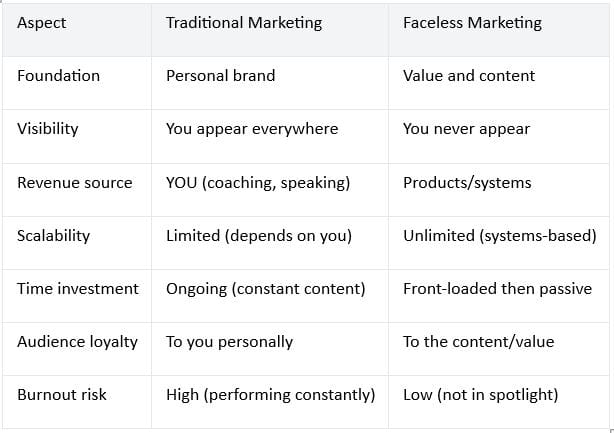
The Core Philosophy
Faceless marketing is built on three principles:
Principle 1: Value Over Personality
Traditional approach: "Follow me because I'm interesting"
Faceless approach: "Follow me because I solve your problems"
People don't care who you are.
They care if you can help them.
Principle 2: Systems Over Presence
Traditional approach: "Buy from me because you trust me personally"
Faceless approach: "Buy from me because my system works"
Your business works whether you're there or not.
Principle 3: Content Over Connection
Traditional approach: "Stay connected with me through my stories"
Faceless approach: "Stay connected with me through valuable content"
People don't need to know you personally.
They need to know your content works.
The Core Components
Every faceless digital marketing business needs these:
Content (Educational posts, frameworks, tips)
Builds audience
Establishes authority
Drives traffic
Email List (Subscribers for direct communication)
Converts better than social
Owned asset (vs. rented social media)
Multiple monetization options
Offers (Products, courses, services)
Something to sell
Solves audience problems
Generates revenue
Systems (Automation, sequences, funnels)
Sells while you sleep
Removes manual work
Scales without you
Traffic (Ways to reach people)
Social media organic
Email marketing
Affiliate partnerships
Paid ads (optional, later)
Part 2: Core Faceless Marketing Strategies
Strategy 1: Educational Content Marketing
What it is: Creating valuable, educational content that solves your audience's problems.
How it works:
Step 1: Identify a problem your audience has
Example: Email marketing confusion
Example: Content creation difficulty
Example: Product pricing decisions
Step 2: Create content that solves it
Educational posts
Frameworks and systems
Step-by-step guides
Tips and tactics
Step 3: Build audience around this content
Post consistently
Engage with audience
Build email list from the content
Step 4: Monetize the audience
Sell solution to the problem
Affiliate recommendations
Courses or guides
Why it works:
People follow because they learn. They buy because they trust. They recommend because it worked.
Timeline:
Month 1-2: Build content
Month 3-4: Audience growing
Month 5-6: First sales
Month 7+: Sustainable revenue
Strategy 2: Email List Building & Monetization
What it is: Building a list of subscribers and monetizing through email.
How it works:
Step 1: Create lead magnet
Free valuable thing (template, guide, checklist)
Solves specific problem
Step 2: Drive people to signup
Posts mention the lead magnet
Link in bio
Stories mention it
Consistent promotion
Step 3: Build email sequences
Welcome sequence (builds relationship)
Nurture sequence (provides value)
Promotional sequence (makes offer)
Broadcast emails (weekly value)
Step 4: Monetize the list
Email promotes products
Email recommends affiliates
Email sells courses
Multiple revenue streams
Why it works:
Email is the highest ROI marketing channel. People on your list are 10x more likely to buy than Instagram followers.
Timeline:
Week 1-2: Set up email platform
Week 3-4: First lead magnets
Month 1: First 100 subscribers
Month 2: First 500 subscribers
Month 3: Making money from email
Strategy 3: Digital Product Sales
What it is: Creating products once and selling them repeatedly.
How it works:
Step 1: Identify what to sell
Solve problem your audience has
Something they'd pay for
Something you can create
Step 2: Create the product
Templates
Guides
Courses
Checklists
Step 3: Setup sales infrastructure
Sales page
Payment processing
Email confirmation
Product delivery
Step 4: Market the product
Email list
Social media
Affiliates
Ads (optional)
Why it works:
Created once = sold repeatedly. Every sale is pure profit (minus platform fees). Scales without more work.
Profit margins: 60–90%
Strategy 4: Affiliate Marketing
What it is: Recommending products and earning commission.
How it works:
Step 1: Find products to recommend
Products you use
Products your audience needs
Products with affiliate programs
Step 2: Get affiliate links
Sign up for affiliate program
Get unique referral link
Track clicks and sales
Step 3: Recommend authentically
Mention in emails
Recommend in posts
Link in bio
Stories and content
Step 4: Earn commissions
People click your link
People buy
You earn 10–50% commission
Why it works:
Zero product creation. Pure commission income. Scales with audience growth.
Timeline to first affiliate sale: 2–4 weeks
Strategy 5: Community & Membership
What it is: Charging members for exclusive community access.
How it works:
Step 1: Build audience first
Need 5,000+ followers
Need engaged community
Step 2: Create community
Slack group
Circle platform
Forum
Private community
Step 3: Set membership fee
Monthly charge (19–99+)
Annual option (discount)
Lifetime access (premium)
Step 4: Provide value
Exclusive content
Community support
Resources
Networking
Why it works:
Recurring revenue. High lifetime value. Engaged community.
Timeline: 6+ months to launch
Part 3: Step-By-Step Implementation Blueprint
Month 1: Foundation Building
Week 1: Research & Planning
What to do:
Choose your niche
What problem do you solve?
Who has this problem?
What would they pay for?
Research the market
Look at competitors
Check what's selling
Identify gaps
Plan your content
What will you post about?
What angle is unique?
How will you differentiate?
Time: 5–10 hours
Output: Clear niche, market research, content plan
Week 2: Account Setup
What to do:
Set up business accounts
Instagram (business profile)
Email marketing platform
Website or landing page (optional)
Design your presence
Logo or brand image
Bio/description
Link in bio
Create lead magnet
Something free and valuable
Solves specific problem
PDF or template
Time: 5 hours
Output: All accounts ready, lead magnet created
Week 3-4: Content Creation
What to do:
Create content library
20–30 posts
Mix of educational, value, engagement
Ready to post
Set up email sequences
Welcome sequence
Lead magnet delivery
Nurture sequence
Schedule posts
Plan posting calendar
Schedule for 2–4 weeks
Prepare responses
Time: 10–15 hours
Output: Content ready to go, emails ready, 1 month of posts scheduled
Month 2: Launch & Growth
Week 1-2: Start Posting
What to do:
Post consistently
3–5 posts per week
Promote lead magnet
Engage with audience
Build email list
Drive people to signup
Deliver lead magnet
Start nurture sequence
Engage daily
Respond to comments
Answer DMs
Build community
Time: 5 hours per week
Output: Growing audience, growing email list
Week 3-4: Optimization
What to do:
Analyze what's working
Which posts get engagement?
Which drive most signups?
What resonates with audience?
Double down on what works
More of the posts that convert
More of the content people engage with
Refine your angle
Plan first offer
What will you sell?
What problem does it solve?
How much will you charge?
Time: 5 hours
Output: Clear picture of what works, plan for first product
Month 3: Monetization
Week 1-2: Create Product
What to do:
Create your first product
Templates, guide, or course
Solve specific problem
Price appropriately
Set up sales infrastructure
Sales page
Payment processing
Delivery system
Create marketing assets
Sales email sequences
Social media graphics
Launch plan
Time: 10–20 hours
Output: Product ready to sell
Week 3-4: Launch & Sell
What to do:
Launch product
Email your list
Post about it on social
Drive traffic
Capture testimonials
Ask early buyers
Use for social proof
Refine offer based on feedback
Plan next steps
What's working?
What needs improvement?
What's next product?
Time: 5 hours
Output: First sales, first testimonials, clear path forward
Part 4: Essential Tools & Resources
Category 1: Content Creation
Templates & Design Tools
Canva (canva.com)
What: Graphic design tool
Cost: Free or $120/year Pro
Use: Creating social posts, graphics, designs
Essential: Yes (core to faceless marketing)
Figma (figma.com)
What: Design tool for professionals
Cost: Free or $12/month
Use: Creating more complex designs
Essential: Optional (Canva usually enough)
Adobe Creative Suite (adobe.com)
What: Professional design tools
Cost: $55/month
Use: Premium design work
Essential: Optional (overkill for beginning)
Category 2: Email Marketing
ConvertKit (convertkit.com)
What: Email marketing platform
Cost: Free or $29/month
Use: Building list, email sequences, deliverability
Essential: Yes (where money is made)
Flodesk (flodesk.com)
What: Beautiful email platform
Cost: $20/month
Use: Email marketing with beautiful designs
Essential: Yes alternative to ConvertKit
Beehiiv (beehiiv.com)
What: Newsletter platform
Cost: Free or $100+/month
Use: Email marketing, easy setup
Essential: Yes alternative
Category 3: Landing Pages & Sales
Leadpages (leadpages.net)
What: Landing page builder
Cost: $25/month
Use: Sales pages, lead capture, simple funnels
Essential: Yes (for conversions)
Carrd (carrd.co)
What: Simple website builder
Cost: Free or $19/year
Use: Simple landing page, lead capture
Essential: Good starting option
Gumroad (gumroad.com)
What: Digital product marketplace
Cost: Free (10% fee on sales)
Use: Selling digital products
Essential: Yes (easiest product sales)
Category 4: Content & Scheduling
Buffer (buffer.com)
What: Social media scheduler
Cost: Free or $5/month
Use: Schedule posts in advance
Essential: Helpful (saves time)
Later (later.com)
What: Social media scheduler
Cost: Free or $15/month
Use: Schedule and plan content
Essential: Optional (Buffer often sufficient)
Notion (notion.so)
What: Note-taking and organization
Cost: Free or $10/month
Use: Plan content, organize ideas
Essential: Optional (but very useful)
Category 5: Learning & Templates
The Faceless Marketing Kit
What: Complete bundle of templates, systems, sequences
Cost: $67
What's included:
100+ Canva templates
4-week content calendar
Email sequences
Social media scripts
Lead magnet templates
Sales page templates
Brand kit
Engagement framework
Essential: Yes (accelerates everything)
Part 5: Common Beginner Mistakes To Avoid
Mistake 1: Choosing Wrong Niche
The problem: Starting with a niche that's too broad or doesn't have a willing audience.
Examples:
"Business tips" (too broad)
"Random advice" (not specific)
"Everything" (no focus)
The fix:
Pick specific niche (email marketing, not business)
Make sure people pay for solutions
Pick something you understand
Mistake 2: No Email List
The problem: Building only social media, forgetting email.
Why it's bad:
Social media is rented (algorithm controls you)
Email is owned (yours to control)
Email converts 10x better
Email is where real money is made
The fix:
Start building email list immediately
Every post should mention lead magnet
Email list is your most valuable asset
Mistake 3: No Offer
The problem: Building audience but never selling anything.
Why it's bad:
No revenue
No way to make this a business
Audience isn't monetized
The fix:
Create product in month 2-3
Give it away free if needed (build social proof)
Have something to sell by month 4
Mistake 4: No Consistency
The problem: Posting frequently for a month, then stopping.
Why it's bad:
Algorithm punishes inconsistency
Audience grows then drops
You're back to zero every restart
The fix:
Commit to 3 posts/week minimum
Don't exceed what you can sustain
Consistency beats intensity
Mistake 5: Wrong Content Mix
The problem: Only educational or only selling.
Why it's bad:
Only education: audience doesn't know what to buy
Only selling: audience leaves (too salesy)
The fix:
60% educational (provide value)
30% entertainment/engagement (build community)
10% selling (convert)
Mistake 6: No Strategy
The problem: Posting random content, hoping something works.
Why it's bad:
Inefficient
Takes longer to see results
Discouraging
The fix:
Have content plan
Know your positioning
Understand your audience
Know what converts
Part 6: Timeline To Profitability
Realistic Expectations
Month 1:
Revenue: $0 (building)
Followers: 100–500
Email subscribers: 0–100
Time invested: 20–30 hours
What you're doing: Setting up, creating content
Month 2:
Revenue: 0–200 (maybe first affiliate sales)
Followers: 500–2,000
Email subscribers: 100–500
Time invested: 8–10 hours/week
What you're doing: Posting, building email list
Month 3:
Revenue: 200–1,000 (first product launch)
Followers: 2,000–5,000
Email subscribers: 500–1,500
Time invested: 8–10 hours/week
What you're doing: Selling first product, building social proof
Month 4-6:
Revenue: 500–3,000/month
Followers: 5,000–15,000
Email subscribers: 1,500–5,000
Time invested: 5–8 hours/week
What you're doing: Scaling what works, creating more products
Month 7-12:
Revenue: 2,000–10,000+/month
Followers: 10,000–50,000
Email subscribers: 3,000–10,000
Time invested: 3–5 hours/week
What you're doing: Optimizing systems, scaling revenue
The Variables
Your timeline depends on:
How consistently you post (1 post/week vs. 5 posts/week)
How good your content is (resonates vs. doesn't)
How focused your niche is (specific vs. broad)
How targeted your audience (right people vs. wrong)
How quickly you monetize (month 2 vs. month 6)
Part 7: Getting Everything Done Fast (With The Right Tools)
The Problem
You now understand faceless digital marketing.
You want to start.
But you're overwhelmed by where to begin.
"What templates do I use?" "What do I post about?" "How do I write email sequences?" "What should my brand look like?" "How do I get started today?"
The Solution
Everything you need is in the Faceless Marketing Kit.
Here's what's included:
Templates (100+)
Instagram post templates (ready to customize)
Email design templates
Lead magnet templates
Sales page templates
Everything you need to look professional
Value: 150–200
Content Calendar
4 weeks of daily post ideas
Copy direction for each
No brainstorming needed
Just follow the plan
Value: 50–100
Email Sequences
Welcome sequence
Product launch sequence
Nurture sequence
Promotional sequence
All pre-written, ready to customize
Value: 80–150
Scripts (50+)
Caption formulas
CTA scripts
Engagement questions
Hook formulas
Never write from scratch again
Value: 30–50
Systems & Frameworks
Brand kit (colors + fonts)
Engagement framework
Implementation guide
Complete roadmap
Value: 60–100
The Impact
Without the kit:
You spend:
Week 1-2 choosing colors and fonts
Week 3-4 creating templates
Week 5-6 writing email sequences
Week 7-8 creating content
Month 3: Finally ready to launch
With the kit:
You spend:
Day 1: Download and organize
Day 2-3: Customize for your brand
Day 4: Start posting
Week 2: Already growing
Conclusion: Your Path Forward
Here's what you understand now:
✅ What faceless digital marketing is
✅ Why it works in 2025
✅ Core strategies that work
✅ Step-by-step blueprint
✅ Tools and resources needed
✅ Realistic timeline
✅ How to get started immediately
The only question is: Will you start?
Everything a beginner needs to start a faceless digital marketing business.
$67 for $376+ worth of professional templates, systems, and frameworks.
Start today. Be profitable by month 3.
Your faceless digital marketing business starts now.
This post contains affiliate recommendations and links. I only promote products and services I personally use, trust, and believe will genuinely benefit my audience. If you purchase through my links, I may earn a commission at no extra cost to you. This compensation helps support my work and allows me to continue providing valuable content. Thank you for your support and trust.
Leave a reply
Copyright © 2022 SuePats.com - nuBeginning.com | All Rights Reserved | PRIVACY POLICY - TERMS & CONDITIONS - DISCLAIMER